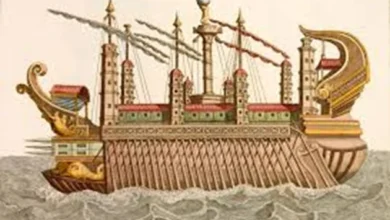
Throughout the history of mankind, people have been constantly at war with each other. In an effort to surpass their enemies, the best minds invented increasingly intricate weapons. Over time, they began to build reliably fortified fortresses to protect themselves from invaders. To enter such an impregnable citadel, one had to be very resourceful. To achieve this goal, ancient armies employed a variety of innovative siege weapons. The level of ingenuity and engineering skill displayed in these complex machines amazes even modern scientists.
10 most ingenious siege weapons in history
1. The Greek Fire
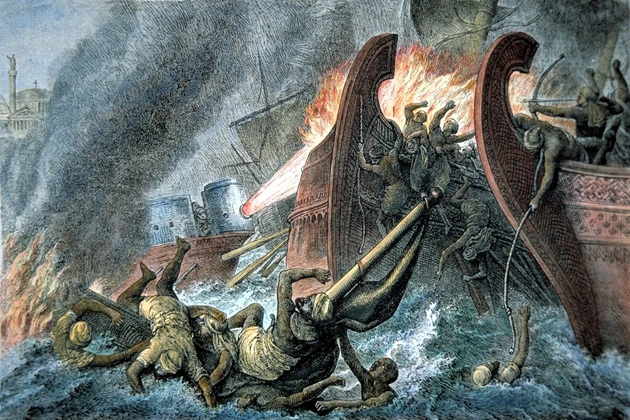
Greek fire is also called the napalm of the Middle Ages. Man has always sought to tame such an unruly and unpredictable element as fire. Naturally, it is used in military battles. The most striking example of the fact that this was quite successful is the famous Greek fire. This formidable weapon was the main trump card of the Byzantine Empire. Unfortunately, the composition of the combustible mixture that was used there has not reached our days. But we can say for sure that this weapon has become the progenitor of all modern flamethrowers.
2. The ram
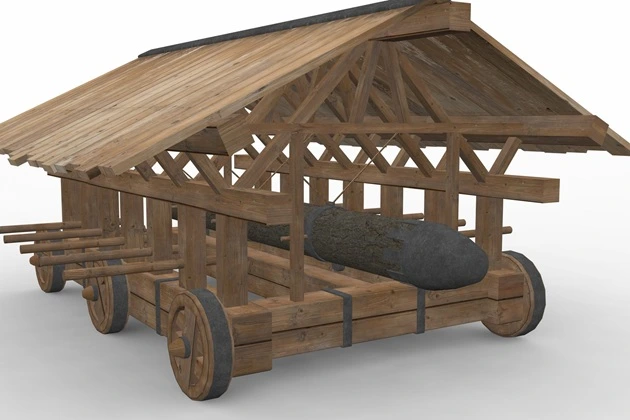
The invention of the battering ram is attributed to the Carthaginians. There are cases of its use by the Assyrians, but most of all, the Romans loved to use it when taking cities. This structure was based on a huge log with an iron tip. Visit. A F R I N I K . C O M . For the full article . Chains attached it to a special frame on the cart. The warriors set it in motion either with ropes or chains, or by hand, destroying the strongest walls or gates.
3. Ballista
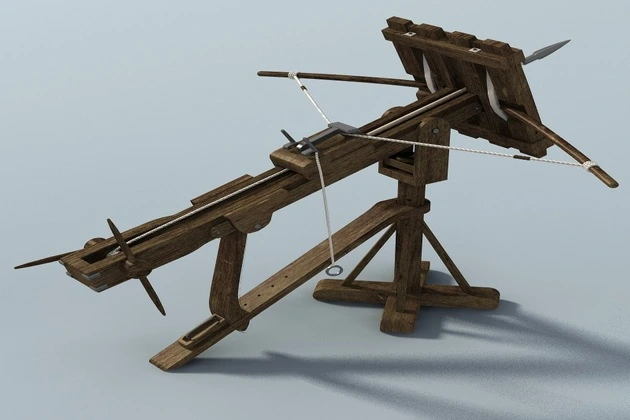
The ballista is an antique two—barrel torsion action machine for throwing stones. The first mentions have been known since the conquests of Alexander the Great. Then it was a kind of new modification of the catapult, which was invented half a century earlier. This structure was heavier and more massive; it was capable of throwing huge boulders weighing up to 30 kilograms. Later in the first centuries of our era, ballistae began to mean arrow-throwers. The ballista hurled huge metal arrows with such force that they could destroy the strongest building in the blink of an eye.
4. The Boeotian flamethrower
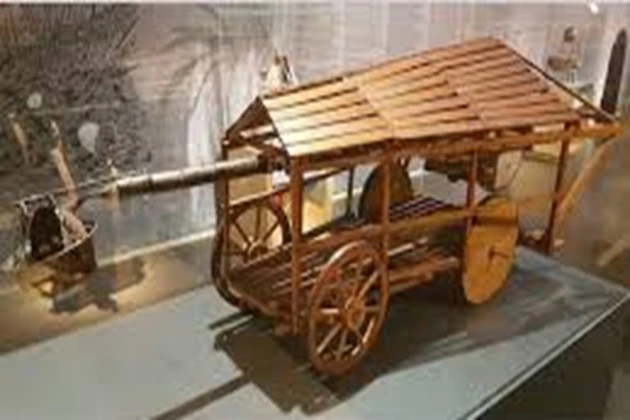
This infernal machine was first used in 424 during the battle for the city of Delhi. The siege had lasted too long, and something truly revolutionary had to be applied. The Boeotian engineers considered the use of conventional battering rams beneath their dignity, and therefore built something completely innovative and intimidating — a giant flamethrower.
The basis was an ordinary wagon or several at once. A hollow wooden structure was placed on them, which resembled a long, straight pipe. Inside this “tube” was placed a metal tube, somewhat similar to the barrel of a rifle with a butt. At one end, a large boiler was attached to it, where something combustible was placed. The outer surface was protected with metal plates. The fuel in the boiler was set on fire. Blowing up the huge bellows standing at the other end, they sent huge jets of devouring fire at the enemy.
5. The Trebuchet
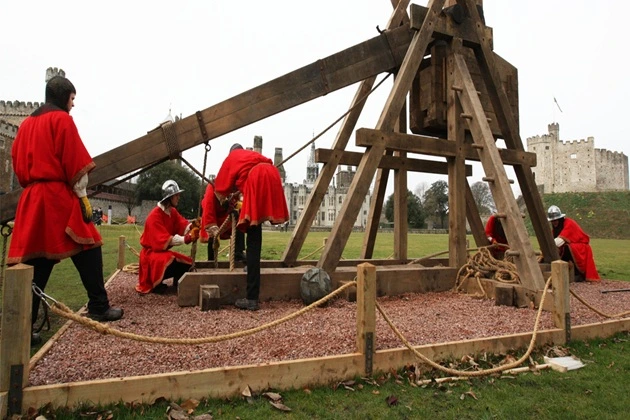
In 1304, the then-English King Edward I besieged Stirling Castle, the last stronghold of the supporters of the Scottish rebellion. Behind the thick walls of the castle, Sir William Oliphant and his loyal supporters spent many months under siege. Edward used probably the richest collection of siege engines in history in this battle, but he could not win in any way. Then he collected all the reserves of lead throughout England and ordered the construction of the most powerful catapult in the world, which was called a trebuchet. She was capable of throwing stones weighing almost one and a half hundredweight.
Interestingly, after seeing this formidable weapon, Oliphant still gave up, but Edward wanted to test his mighty machine by all means. They even built a special viewing platform for her trial and invited all the courtiers. The King was pleased with the effect.
6. The Claw of Archimedes
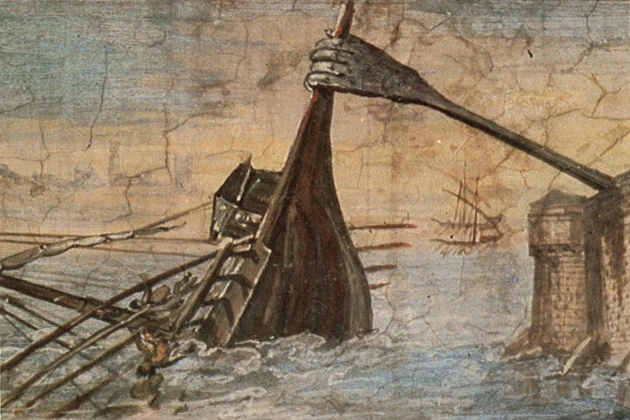
When defending Syracuse from the Romans, Archimedes used many interesting weapons. The most famous of all was probably the Claw of Archimedes. The Romans also called him the “iron hand.” Some scientists doubt its reality, but many eminent ancient Greek historians mention this tool in their writings. They did not describe any special details of its design. It is only known that it looked like a well crane. Only at the end of it was attached not a bucket at all, but a giant metal hook. This “claw” easily lifted the ships of the Roman invaders and sank them.
7. Siege towers
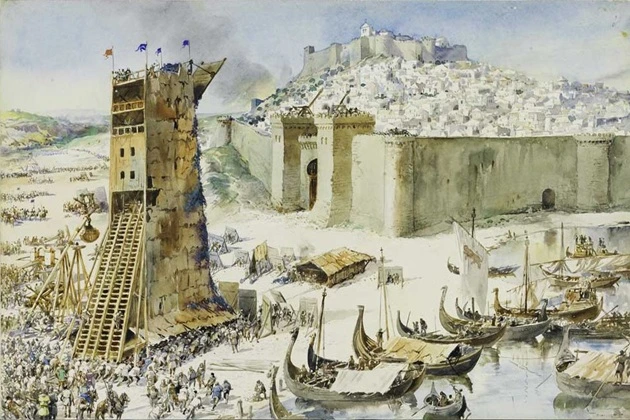
The siege tower was a giant wooden structure divided into several “floors”. Soldiers were stationed on each of them. There were always archers on the top floor. To protect the tower from fire, it was covered with some non-combustible materials.
8. Exploding mill wheel
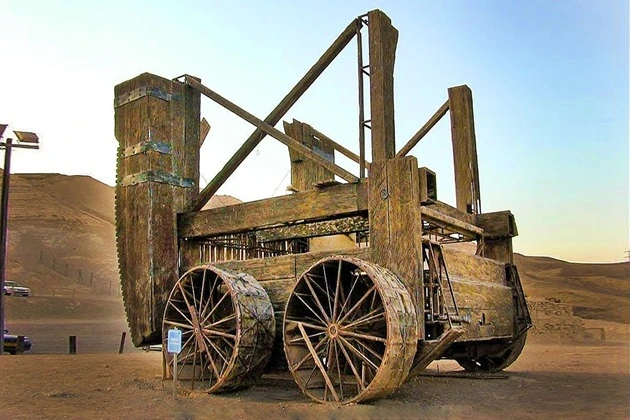
In the middle of the 16th century, the Ottomans besieged the Hungarian fortress of Eger. The castle was an impregnable citadel. It was wisely built on top of a large hill, and this gave a huge advantage to the defenders. The besiegers bombarded the fortress endlessly. We needed some kind of weapon that could be guaranteed to destroy the attackers.
One of the locals, whose name was Gergely Bornemissza, came up with something absolutely brilliant and at the same time quite simple. He filled an ordinary mill wheel with stones and gunpowder. The mill wheels were rolling down the hill at an incredible speed. They rolled to the enemy’s camp and exploded there, scattering burning splinters and red-hot fragments of stones far away.
9. The plague
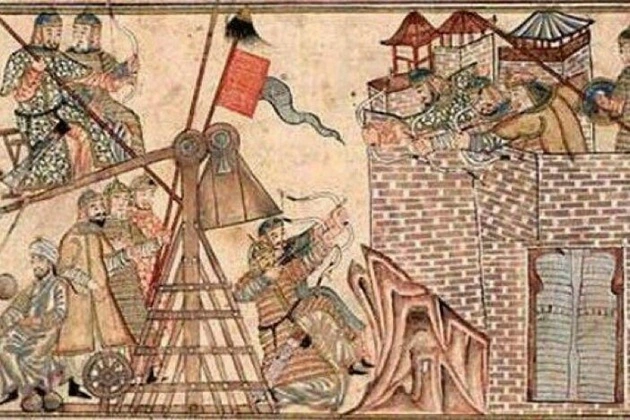
When a fortress is so securely defended that battering rams and catapults are useless, the attackers need to show much more sophistication in order to succeed. A very ingenious solution was once found by the Mongols, who were besieging the city of Kaffa (now Feodosia) in the Crimea. Army camps have never been a model of sanitation, and even more so in the Middle Ages. Epidemics broke out there very often, which mowed down soldiers worse than any weapon.
The most terrible disease then was the plague. So the Mongols came up with the idea of launching plague corpses into the besieged city instead of ordinary stones. It was brilliant, a biological weapon from the Middle Ages. The disease has done everything for them. The Mongols later used this practice in Europe.
10. Archimedes’ Death Ray
Archimedes’ death ray is a terrifying weapon that many scientists consider mythical. With the help of a system of specially constructed mirrors, this monstrous cannon sent a beam at the enemy, which easily set fire to wooden ships. Ancient Greek historians wrote about this invention. They described how Archimedes’ ingenious invention destroyed the enemy Roman fleet and saved Syracuse.