Antiquity and the Middle Ages are our favourites. When people were different, holding a sword properly meant more than writing, counting, or contemplating art. There was less pathos, duplicity, and doublethink. Things were simple: You have a family and a sword to protect it. Timely brutality accompanied the truth. How was truth determined? Yes, the sword: Here are the most intriguing ancient edged weapons.
5 Swords that changed the course of history
1. Khopesh

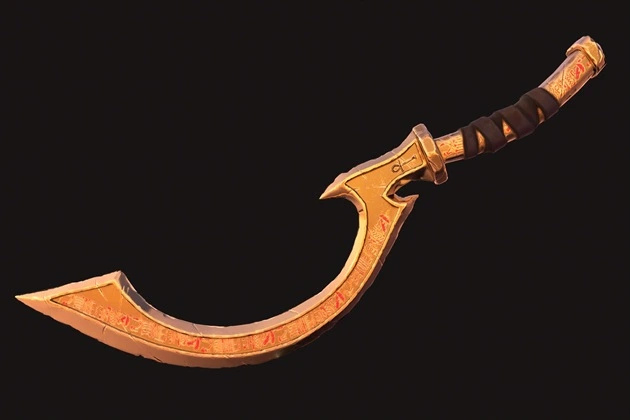
Ancient Egypt is certainly one of the oldest and most unique civilizations in the world. And although the former greatness has long since disappeared along with the life and ambitions of the pharaohs, the memory of Egyptian weapons is unlikely to ever sink into oblivion. Let’s take as an example khopesh (khopesh), which has become a real symbol of the New Kingdom. The khopesh consists of two parts: a crescent-shaped blade and a 60-centimeter-long hilt. This blade was common among the elite units of Egypt, it could have both single and double sharpening. It is believed that this weapon originated from an older Sumerian counterpart.
The ancient Egyptians were famous for their ceremonial, and therefore such weapons could often be found in tombs. Technically speaking, khopesh is famous for its punching ability. They were attacked by both foot soldiers and those who were in chariots (the length allowed). The weapon’s weight (up to two kilograms) and unique shape allowed ancient Egyptian warriors to vary their attack style depending on the conditions. Simply put, it was possible to chop with it, or it was possible to stab with special skill.
2. Xiphos
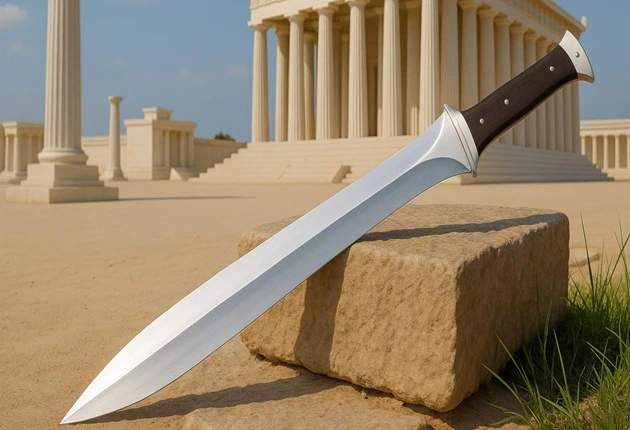
The Hellenes learned a lot from the Middle Eastern peoples, but their military tactics were unique. Of course, it is impossible to single out from such a fateful people any particular weapon that stood out from the others. And although the Greeks are better known as spearmen, we chose xiphos, which is a characteristic auxiliary weapon of the Hoplite or phalangite. “We use short swords in war because we fight close to the enemy.” The Xiphos is the true forerunner of the Roman gladius. It was a straight double-edged sword with a length of 50 to 70 centimeters. This Greek blade had its own bronze ancestor, which belonged to the Mycenaean civilization.
But xiphos was not made of bronze, but of iron, and it was shorter. The hilt was made of bone, wood, or bronze, and the scabbard was made of two wooden slats, which were covered with leather and decorated in various ways. As a rule, this sword was used only when the spear was broken or the formation was broken. By the way, the Spartans, who terrified their enemies, shortened the already short blade almost to the state of a dagger, and all because they liked to fight close to the enemy.
3. Gladius
This sword, which made Rome famous, is by and large an interpretation of Xiphos. However, Livy, one of the most famous Roman historians, has a different opinion on this matter. His opinion was that the gladius originated from the Celtic periods of the La Tène and Hallstatt cultures.But the debate about this does not subside, and this is not the main thing. Anyway, this sword will remain in history as a symbol of the main argument of any Roman.
Gladiuses were made of higher-quality metal than xiphos. In addition, the tip had a wide cutting edge, and the center of gravity was balanced by the pommel, which fell on the handle and represented a ball. The blade was, of course, short, and it was intended for combat. Roman soldiers, as a rule, used thrusting blows, and the chopping ones were left to the recruits. The latter were considered ineffective and typical more of an inexperienced boy than for a Roman legionary.
4. The Carolingian Sword
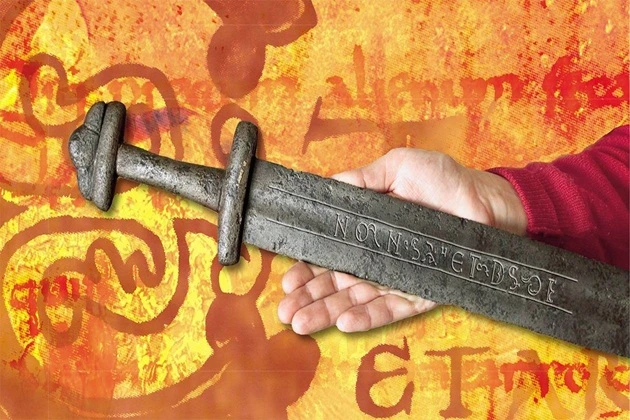
It is a shame not to know who Charlemagne is and why the sword, which was common in the early Middle Ages, is named after the dynasty he founded. However, the name is very arbitrary. It’s just that historians found it necessary to name the weapon after the dynasty that left a huge mark on the history of Europe and formed, roughly speaking, the first kingdoms in the West. The Carolingians had already outlived their usefulness by the time this sword was distributed. But the Vikings flourished and terrified the Christian settlements.
So, the great migration of peoples has ended, and the construction of states has begun. People needed a sword that was practical, high-quality, and accessible to everyone. The Carolingian sword had all these qualities: the hilt was easy to assemble, decor was not required, there was a double-edged blade 70-80 centimeters long, with a wide shaft, as well as a short handle with a small guard. The weight of such a sword did not exceed one and a half kilograms.
5. Romanesque Sword
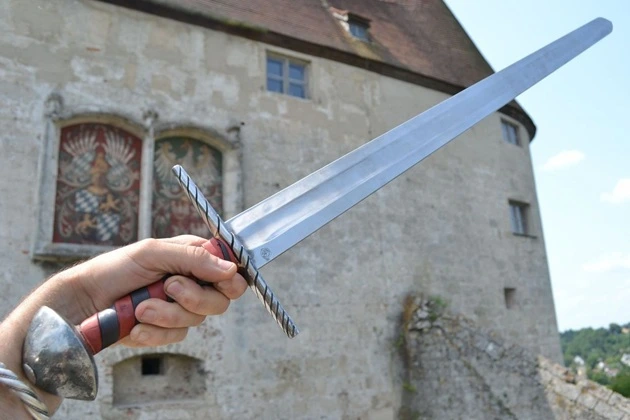
Perhaps the most famous sword of the Middle Ages. It was used only by elite troops, or to be more precise, by knights. But even in Russia, the Romanesque sword was distributed mainly among the princely retinue. It was this weapon that was an attribute of any noble; it was a real status item, access to which was closed to commoners. It was from this sword that the concept of honor appeared in the most titled military class of the Middle Ages. Romanesque swords could be decorated with stones and gold, but more modest swords were used for combat, because a sword is primarily a weapon that kills for the glory of a suzerain, king, or Lord.
This personification of the High Middle Ages has a very broad classification. The hilts and blades could differ from each other, but they were always wide (about 4 centimeters) blades. Romanesque one-handed swords were a meter long, of which 7-12 centimeters accounted for the hilt. Two-handed, or (as they are also called) Romanesque “fighting” swords had only one blade of at least 100 centimeters, and the length of the hilt was in the range of 15-25 centimeters.
The weight of such a monster sometimes reached 2-3 kilograms. The pommel was a knob made of iron or bronze, which was sometimes decorated with coats of arms, engravings, and precious stones. The Romanesque sword had a guard that helped protect the hand during combat, which set it apart from the Carolingian sword, where the guard was excessively wide and short.