Mao Zedong’s personal habits: What his doctor revealed after his death

Mao Zedong was the leader of the Chinese Revolution. The founder of the PRC was also one of the most influential political figures of the 20th century. The era of the Cultural Revolution and the Great Leap Forward meant millions of broken lives. People know about it. But few people know about the quirks and unusual habits of this man. He avoided brushing his teeth, instead rinsing his mouth with tea. He washed very rarely, considering it a relic of the bourgeois world. The leader’s quirks are mentioned by his personal physician, Lee Ji-suo, in his diaries.
Childhood in the countryside and the emergence of unusual habits
Mao Zedong was born into a peasant family in Hunan Province on December 26, 1893. At that time, China was a country where the majority of the population was engaged in agriculture. Hygiene was considered an excess. The peasants washed no more than once a week, using rivers or puddles. Salt or ash was used instead of toothpaste. Jonathan Spence notes in his biography “Mao” that the young Mao adopted these customs, considering them to be part of folk wisdom. While studying in Changsha in the 1910s, he began to try “natural” ways of self-care. For example, I replaced the toothbrush with green tea and the soap with hot water. By the 1920s, when Mao became the head of the Chinese Communist Party, these habits had already become very firmly entrenched.
In the “Red Capital” of Yan’an, during the “Great Campaign” (1934-1935), hygiene could only be dreamed of. The revolutionaries slept in caves and ate everything from the same dish. Mao, as a leader, had the opportunity to take a bath, but neglected it. It was unhealthy to wash, he thought. Zhi-suo, his doctor, wrote in the book “The Private Life of Chairman Mao” (1994) that Mao believed in self-cleansing of the skin and considered frequent washing harmful to the “protective layer”. And it wasn’t laziness. Mao saw hygiene as a “bourgeois vice” that distracted from the struggle for class interests.
Rare water treatments and terrible consequences
Mao preferred to take hot baths once a month or even less often. He spent long hours in the water, reading books or chatting with visitors. He considered the shower and soap to be nonsense, fearing harmful effects on the skin. In the 1950s, during the Great Leap Forward, Mao adamantly rejected the advice of doctors. He said that the peasants don’t wash, but they live. The neglect of hygiene has not gone unnoticed. The consequences were not very pleasant. Mao’s skin would become crusted, and his smell would become disgusting to others. A special heated bathtub was installed for him in the Forbidden City of Beijing, but he rarely used it.

Doctor Li Ji-suo noted that Mao, because of his unwillingness to wash, transmitted sexually transmitted diseases to young women from his entourage, the number of whom could reach ten per day.Visit. A F R I N I K . C O M . For the full article. This caused scandals: his wife and mistresses complained of illness, but in the context of the cult of personality, no one dared to object to him.
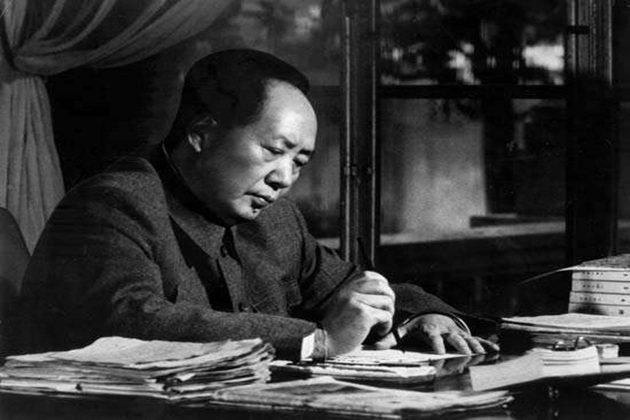
Mao believed that washing was an unnecessary waste of time and energy. Therefore, he usually only allowed the servants to wipe his body with wet towels soaked in hot water. And all this often happened right at his desk, while he was going through the papers. Well, at least that way. However, the leader loved to swim. He even took part in river swimming tournaments. However, he always turned out to be the winner. No one wanted to expose themselves by swimming across the river faster than Mao.
Tigers don’t brush their teeth
Mao Zedong did not pay proper attention to oral hygiene, and this was the secret of Polichinelle. He preferred to rinse his mouth with green tea, believing in its antimicrobial properties and benefits for gums. He also chewed tea leaves daily. By adulthood, Mao’s teeth were covered with a dense, almost indelible plaque from tea and tobacco, which he consumed in large quantities. Dental health was undermined.
Mao Zedong’s personal physician, Li Zhisui, described the deplorable condition of his mouth: yellow, rotting teeth and inflamed gums. Any modern person knows that this state of affairs can cause irreparable damage to health. And it’s not just the loss of teeth and the appearance of ulcers — the whole body suffers. Mao ignored the doctor’s urgent recommendations to use a toothbrush. He said that tigers don’t brush their teeth, and he sees no reason to do so either. This is a reflection of his commitment to the Taoist philosophy of naturalness.
This habit has led to unfortunate consequences. His immune system was weakened due to chronic dental problems. Before his death in 1976, Mao lost all his upper teeth, but categorically refused dentures. According to Dr. Lee, such a refusal was part of an established “personality cult.” He wanted to appear close to the people, a simple leader. Prosthetics seemed to him an unnecessary luxury. As well as daily washing, the use of toothpaste, soap and shampoos.
Is the leader a dirty man or an ideological man?
What made Mao neglect his health so much? Ideology? Stubbornness? Rather, it’s an explosive mixture of both. Historians are still arguing, trying to understand what motivated this extraordinary man. On the one hand, he always emphasized his closeness to the people, to ordinary peasants. He believed that “bourgeois” habits were something alien, imposed by the West. And now he, the leader, refuses to use a toothbrush, as if challenging the entire capitalist world.
On the other hand, eyewitnesses (including his personal physician, Dr. Li) claimed that Mao was just as stubborn as an ass. It was difficult for him to admit he was wrong, even when it came to his own health. The doctors kept telling him one thing, but he did it his own way. They say I’ll live 150 years without your persuasion! The result, alas, is sad. Diseases do not spare either leaders or ordinary mortals. Strokes, lung problems, and constantly inflamed gums all undermined Mao’s health. In the end, his heart couldn’t take it anymore. On September 9, 1976, China was orphaned. There is unpredictability and chaos ahead.