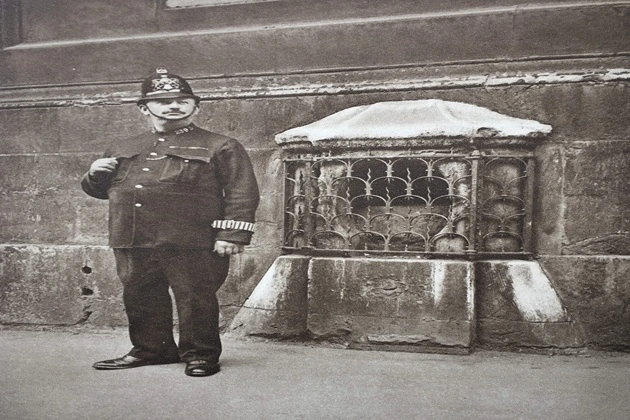
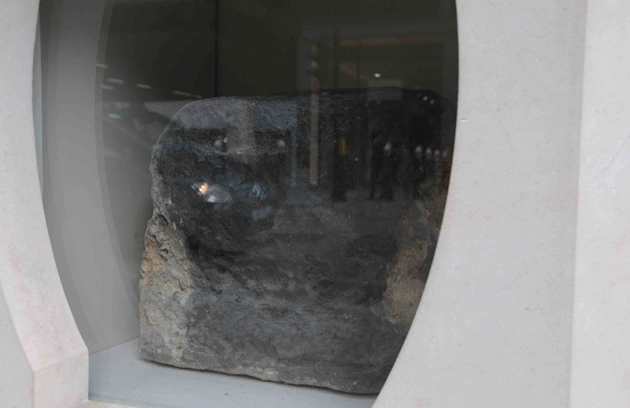
Thousands of people walk down Cannon Street in central London every day, within walking distance of the Tower of London, ignoring the small barred window in the basement of 111 with a glass case built into the wall, resembling a decorative hatch with dim lighting. If you look inside, you can see a large, unremarkable stone of irregular shape, but this is only at first glance, if you do not know its amazing history.
The History of the London Stone

The most unusual thing about the history of this stone is that no one really remembers it, although the stone has been stored in this place for more than a thousand years, and residents of the capital firmly believe that London will exist as long as the stone remains here. The origin story of the mysterious “London Stone” has fascinated people for centuries. His composition was studied by scientists, historians tried to find out about his past, and Shakespeare, William Blake, and Dickens mentioned him in their works. But the true history of the stone has been lost for centuries, and now there are only assumptions, although the stone is considered one of the oldest and most important relics of London.
He has been in this place for at least a thousand years, and possibly more than one thousand. The appearance of the surrounding streets changed, wars broke out, natural disasters occurred, generations of London residents changed, the history of the stone was forgotten, interpreted in different ways, and overgrown with legends, and it continued to lie in this place.
Although his appearance has also changed over time. The first written mention of the “London Stone”, as it was called at all times, occurs at the end of the XI century, where it was described as a huge block of stone embedded in the ground. Visit. A F R I N I K . C O M . For the full article. In the 16th century, the English historian John Stowe described the stone as “a serious obstacle for a cart that could break if it accidentally ran over it.”
It is known that in the 18th century it lay in the middle of Candlewick Street, later renamed Cannon Street, and posed a serious obstacle to movement, which is why it was moved to the north side of the street. About half a century later, the stone was embedded in the south wall of St. Swithin’s Church, where it remained until its demolition in 1962, and then was moved to a purpose-built room on Cannon Street.
What is the mysterious “London Stone”?
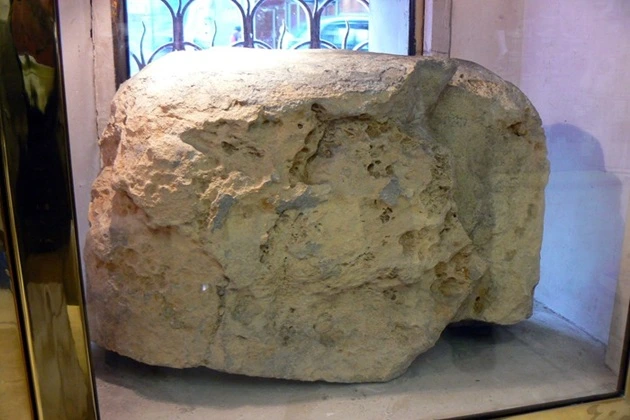
Thus, the stone that we see today is only a part of the original stone, which, according to researchers, was once much larger, but now has about fifty centimeters in diameter and is placed in a small glass case. It is believed that the stone could have been damaged during movement or during natural disasters, when it split into several pieces, and only one of its fragments was preserved. Perhaps this could have happened during the Great Fire of London in 1666.
The location of the stone in the middle of the street obviously saved it from destruction, but it was after the fire, when the reconstruction of the city began, that an amazing discovery was made. It turned out that the part of the stone visible on the surface was only a small part of it, and it itself, like an iceberg, went into the ground to a depth of up to three meters. In 1940, the stone once again suffered destruction when the church in which it was built was damaged during the massive bombing of London by Nazi aircraft.
Research conducted in the 1960s showed that the “London Stone” is an ordinary piece of limestone that could have been extracted from a Jurassic Era cliff running from Dorset in southwestern England to Lincolnshire in the northeast. A later examination conducted by the London Museum of Archaeology in 2016 confirmed the limestone origin of the stone and suggested that it may be “native” to the Cotswold region, which is located 160 kilometers west of London. However, how the stone got to the center of London and for what purposes it was brought there remains a mystery to this day.
Myths and legends surrounding the ancient relic

Legends about the “London Stone” began to be composed back in those ancient times when people could remember its true history. But legends always sound more attractive, so one of them, which the architect Christopher Wren mentioned in his notes back in the 17th century, is still widespread today. According to this legend, in ancient times, the stone could serve as a zero kilometer, from which the length of all roads leading to London was counted, according to the principle of the golden milestone in Rome. But in our time, this theory has not been confirmed. There were also suggestions that the stone could have been used by druids as a place of worship.
Over the centuries, legends and legends have become more and more intricate. By the beginning of the 19th century, there were many mentions that the stone was part of an altar or foundation dating back to the time of Brutus of Troy, the legendary fictional hero, descendant of Trojan Aeneas, known in medieval British legends as the founder and first king of Britain.
According to another legend, which was immortalized in Shakespeare’s work, in 1450, when the leader of the peasant uprising, Jack Cade, captured the city, he struck his sword against this stone, declaring himself the ruler of the city. Since then, the stone has been considered a relic of London and its eternal amulet, assuring that if something happens to the stone, the city will certainly fall. Of course, most of these stories are just legends and myths, and there is little to indicate a reliable history of the stone before the Middle Ages.