Imagining India, images of fakirs, strange half-naked Hindus, and women in bright-colored saris appear. It seems strange that in the 21st century in this country they have not switched to European clothes – trousers and dresses, but continue to wrap themselves in a long piece of cloth. But in fact, the woman is wrapped in history, in myths, in the skill of weavers who had their fingers cut off, and prayers to the goddess Lakshmi. The whole universe is hidden behind this seemingly simple piece of matter.
A unique “dress” of Indian women
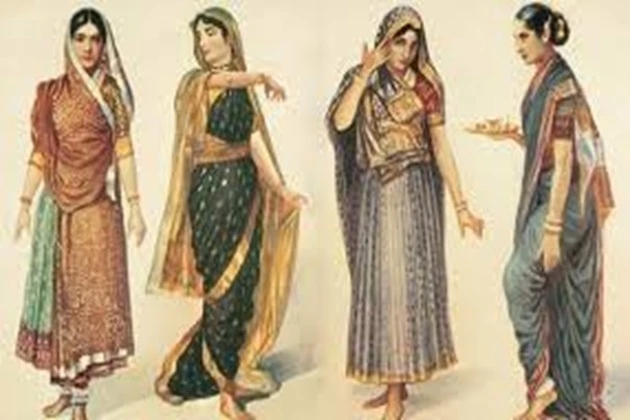
Dry facts without poetry say that a sari is a rectangle of fabric from four and a half to nine meters long and slightly more than a meter wide. But if you look at the root, the sari is perhaps the smartest clothing design that mankind has come up with. No zippers, buttons, hooks, or seams. Only fabric and feminine hands that know how to handle it. It is considered “clean” because, according to cultural heritage, clothes pierced with a needle are considered “unclean”, leaving a trace of the tailor’s karma.
The most popular way of wearing it is called “nivi”. It looks like this: one end of the fabric wraps twice around the hips, draping the legs, the upper edge hides behind the belt of the petticoat, and the rest is thrown over the shoulder. Everything ingenious is simple, but not everyone can repeat this trick the first time.
Under the sari, one must now wear a choli, a short, tight—fitting blouse and skirt. The free end hanging from the shoulder is called a pallu. Going outside, a woman can throw it over her head like a shawl, and this is not just a gesture of modesty, but a whole body language with which she tells others: “I’m married,” “I’m in a temple,” or simply “it’s too hot.” Previously, Indian women did not consider their naked bodies to be something shameful and wrapped themselves only in saris, not being shy if a part of their body was visible to others. Therefore, there is still a dispute about the choli – it was imposed by the British when they saw half-naked Indian women, or it is a native Indian invention.
The legends of sari creation
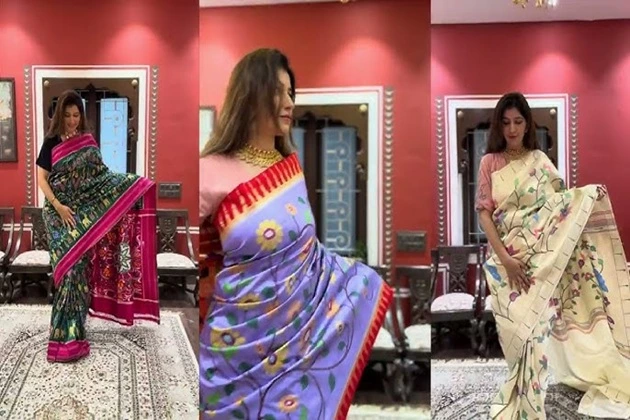
The antiquity of the creation of the sari was confirmed by the discovery of archaeologists. They found a statuette of a priest of the third millennium BC in the Indus Valley, and judging by the shape, his clothes had folds of drapery, very similar to those that are now wrapped in saris. It comes from the Prakrit “sattika”, and in Sanskrit, “sati” means “strip of cloth”. But the dry text of the explanation is full of deep meaning for Indians, because it means the universe to them. After all, it is woven from a thread, and this is the basis of the universe. It may sound grandiloquent, but if you pick up a real handmade silk sari, you can believe it.
There is a more touching legend that the sari was born on the loom of a weaver in love. He sat and weaved, dreaming of the woman he loved. He worked day and night, so the fabric turned out to be very long, and when he stopped and looked at his creation, he just laughed and then presented it to his beloved, who wrapped herself in a delicate strip of fabric. There is another legend in which Sari saved her owner.
The Pandava king lost everything he had at dice, and he bet Draupadi’s wife on the last bet, which he also lost. Visit. A F R I N I K . C O M . For the full article. The winners wanted to show their superiority and brought the woman to the square to undress her and abuse her. But God Krishna stood up for her – no matter how much the enemies unwound the sari, she still remained wrapped in it.
The color of the sari in a conversation
In India, a woman with her outfit can silently say who she is without saying a word. These are social status, marital status, religious affiliation, and even mood, all rolled into one roll of cloth. An Indian woman chooses a color not because it suits her eyes, but because it tells the truth, which she does not say out loud.
A red sari is worn for a wedding, because in India it is luck, fertility, that primal force that swirls in the blood and gives new people to the world. When a married woman goes out to celebrate in a red sari, she carries the blessing of Lakshmi herself, the goddess of prosperity. But red isn’t just about money and kids. It is also Shakti, the feminine creative energy, and the purifying fire. The bride who goes out in red doesn’t just speak — she declares to the universe: “I am ready to create a new life,” and her statement will be heard.
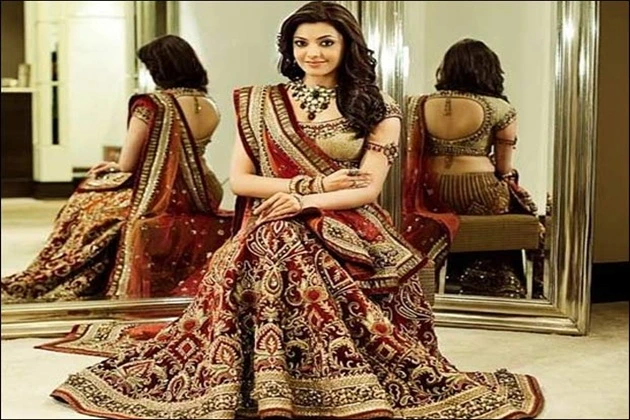
In some parts of India, the bride may wear a green sari instead of a red one, and this will not surprise anyone, because in these parts green is also considered a blessed color. Yellow is the color that happiness dresses in. A woman wears a yellow sari after giving birth, especially if a boy is born. It is believed that this color is able to purify. And with the white color, not everything is so clear. If in the West, brides dream of a white dress, a symbol of purity and a new beginning, in India, it is mourning.
Widows wear a simple white cloth without a single ornament, without embroidery, without a border. Like asceticism, sorrow, and the voluntary disappearance of color and joy from the world. But there is another white one. In South India, it is treated differently, where white is compared to a blooming lotus. The same color, but two completely different worlds in the same country.
Blue has long been a cursed color due to the hard and grueling labor involved in making it. But since then, color has been associated with a lower caste. Times have changed, and today everyone is wearing blue. He turned into the color of strength, dignity, and elegance. And finally, black, which is considered forbidden. It is avoided at weddings, birthdays, and during pregnancy. It is believed that he attracts trouble like a magnet. But Indian women are tricky people. Some of them wear black saris to ward off evil. That’s how they live: in a world where every color is a whole story, and every sari is a confession.
The color of the sari as a resistance to the climate
Different parts of India have different saris, and this is not a whim, but a harsh necessity dictated by climate, landscape, and traditions. For example, in Rajasthan, where the sand and the sun burn out all life, women wear saris of incredibly bright colors: fuchsia, orange, and poisonous green, as if defying the ruthless nature.
In Kerala, the state of green palm trees and endless rains, everything is different. The traditional sari is white or cream with a gold border. This border is called “kasavu”, and it symbolizes purity and simplicity. It is believed that the Kerala sari is minimalism brought to perfection. Bengal is generally a separate story. White saris with a red border are adored here – the color of the goddess Durga, one of the most revered in these parts. During the Durga Puja festival, the whole of Kolkata turns into a sea of white and red, a breathtaking sight.
Sari is not only about color and beauty, but it’s also about blood
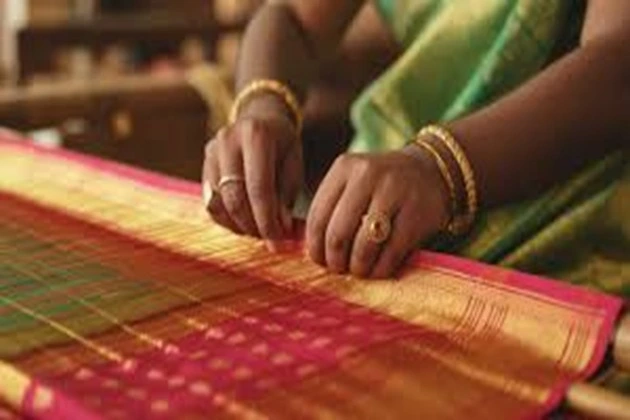
Long before Europe even knew what a loom was, India already knew how to make fabrics that had no equal. Cotton, linen, silk — all this was born here, grew up, and turned into an art that men stood behind, because they were the weavers in India. The craft was passed down from generation to generation to sons, so everyone had their own secrets and patterns; for this reason, they were unique, and no machine could replicate them.
Then the British came along, and a new cycle began. When they saw Indian fabrics, they realized that their factory products were much inferior to them in quality. But instead of eliminating their flaw, they resorted to harsh measures – they cut off the craftsmen’s thumbs so that they could no longer weave. So they eliminated their competitors, and it remained one of the terrible pages in the history of Indian textiles.
Weaving in India has survived after all, because it is impossible to take away national identity and knowledge by chopping off a finger. The masters secretly taught the children and withstood the challenge that the foreigners threw at them. Indian fabrics have remained beautiful, and women continue to wrap themselves in comfortable saris.
They cook meals, take care of the children, do all the housework, bathe, and no one has yet complained that it is uncomfortable in such clothes. And there is also a tradition – women wear the most elegant saris at home for their husbands and families, and go outside in simpler ones to be more modest. The exact opposite of the European style, when people wear simple home clothes at home, and in order to “go out in public”, they wear the best outfits.