This unusual, extreme, and quite dangerous occupation, which came to us from the depths of centuries, has always excited people’s imagination. One of the main reasons people practice walking on burning coals is the sense of inner strength and self-confidence they gain once they accept their personal challenge, overcome fear, and step onto the coals. This ancient ritual has a rich history, but there is still debate about what lies at the heart of this experience – mysticism or physics, or maybe some still unexplained processes?
A brief history of the ritual of walking on coals
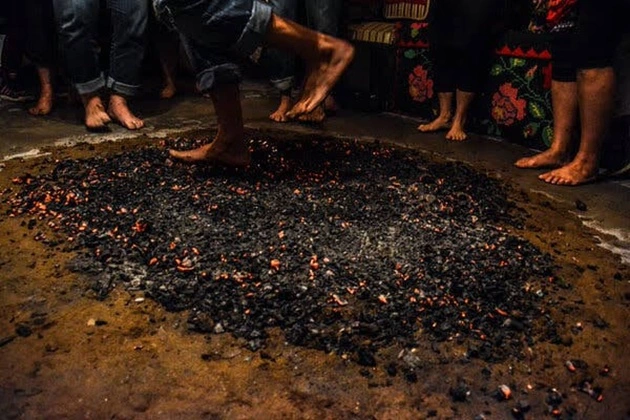
The ancestors of modern humans learned how to use fire for their own purposes about 1.5 million years ago, and since then it has become an important part of our lives. People needed fire; they used it to heat themselves, cook food, and put fire at the center of their ceremonies, celebrations, and rituals. Where and in what period of human evolution the practice of walking on burning coals originated and what was the purpose of this ritual remains shrouded in mystery. It is believed that it originated in different parts of the globe independently of each other many millennia ago, and has since penetrated into every culture on the planet.
The earliest mention of this ritual is found in India and dates back to the Iron Age, where more than three thousand years ago ascetics walked on hot coals to purify their souls. The ancient Greeks and Romans were also committed to this ritual in honor of worshipping their gods. The Old Testament of the Bible contains stories about invulnerability to fire, such as the story of Meshach, Shadrach, and Abednego, who were thrown into the furnace by Nebuchadnezzar and remained unharmed. In the Middle Ages, the ability to walk on hot coals was sharply condemned by the Christian Church, considered a “deal with the devil,” and was persecuted.
But this ritual has been preserved in different cultures and has become part of the cultural heritage in many eastern countries, as well as in Spain, Greece, Bulgaria, and Argentina. Visit. A F R I N I K . C O M . For the full article. Most often, walking on burning coals is performed for ritual purification, healing, and worship, as a rite of passage or initiation, or as a test of a person’s strength and courage.
Getting out of your comfort zone, fighting fears, and unlocking your potential
In different cultures and over the centuries, this ritual has served the same purpose: to strengthen the mind, awaken courage, and reconnect a person with his inner strength. And today, this powerful ritual is designed to help a person get out of their comfort zone and learn how to overcome, acknowledge, and transform their fears. Fear is a natural human emotion, and each of us experiences it from time to time. But sometimes fear prevents a person from doing something important in his life, preventing him from developing spiritually. Anxiety and panic disorders have become serious mental health problems.
Walking on burning coals helps people get out of their comfort zone and change the energy of their fear, turning fire into a powerful ally. The point of walking on fire is not to deny fear, but to see it as an obstacle on the way to the goal and be able to overcome it. This skill will teach a person to successfully deal with their fears whenever they arise, and turn certain frightening situations into opportunities for their personal growth.
Behind the smoldering coals lies a realm of untapped potential, waiting to be discovered by those who are brave enough to take the first step. Walking on fire is not only something that a person’s legs can withstand, but it is also something that his mind and heart can achieve. This is akin to the awakening of extraordinary mental abilities observed in phenomena such as acquired savant syndrome, when the body becomes a conduit for the release of hidden possibilities.
The spiritual principle that dominates matter
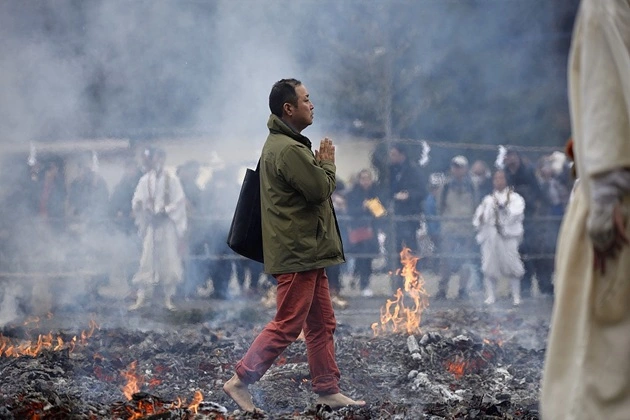
Walking on fire is an exciting sight, and the uninitiated always wonder why people who perform this ritual remain immune to fire and probably don’t even feel pain when stepping on embers. This has both psychological and physiological explanations. First of all, walking on burning coals is a powerful psychological factor. Whether it’s a traditional religious ritual or an activity aimed at personal development, it requires a person to overcome fear and commit an act that seems to contradict common sense.
This psychological component can be so strong that a person may not actually experience pain, explaining this by divine intervention, personal willpower, or a heightened state of mind. The researchers suggest that this may be an example of “dissociation,” a psychological condition in which the human mind disconnects from certain aspects of reality. During seminars on personal development, walking on fire is often used to illustrate the power of mind over matter. It serves as a metaphor for overcoming difficulties. It is believed that if a person can overcome himself and step on hot coals, he will be able to overcome any obstacles in his life.
Physiological aspects of walking on burning coals
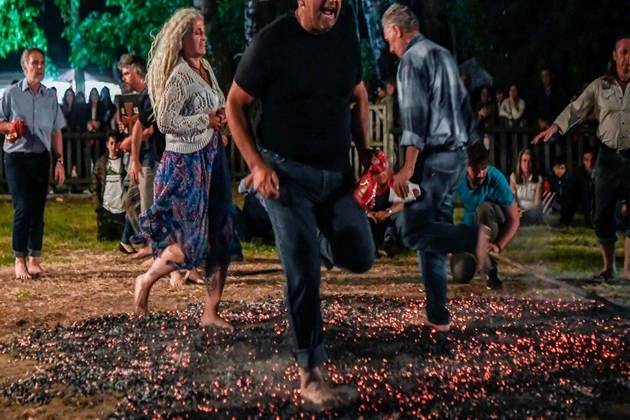
However, to fully understand this phenomenon, it is necessary to consider not only the psychological factor, but also the physical principles that make it possible. There is a scientific explanation that helps to understand how the principles of thermal conductivity and human physiology interact, allowing one to move on hot surfaces without burns. Of course, everyone who sets foot on this path undergoes appropriate training.
The coals used in these rituals have special properties that play a crucial role in this process. They have a low thermal conductivity, which makes them less effective in transferring heat to the human foot, which, due to wetting with water, a mandatory procedure before the ritual, acquires a high specific heat capacity. The key aspect is the insulating layer of ash formed on hot coals. Ash is an excellent heat conductor, creating a buffer between the heat source and human skin.
This means that the temperature of the foot changes less during short-term contact with hot coals, and due to blood circulation, heat dissipates quickly, reducing the burning sensation and the likelihood of injury. The pace of movement is equally important – those walking on hot coals spend minimal time on them and move quickly, which limits the duration of exposure to fire and makes it possible to achieve the goal.