Mankind has always strived to create monumental buildings. Pyramids in Egypt, Colosseum in Rome, medieval castles all over Europe. In the modern world, resources are used somewhat more efficiently. The most grandiose buildings of the XX–XXI centuries are dams, bridges, residential skyscrapers, some stadiums, and maybe even cosmodromes. Today, we could surpass any wonders of the world of past eras, but we no longer create architectural monuments for the sake of art. Everything should have an applied meaning. The goals can be very different. For example, the concealment of some of the most unethical episodes of history.
5 famous landmarks that hide dark secrets
1. “Murder Castle” by Holmes
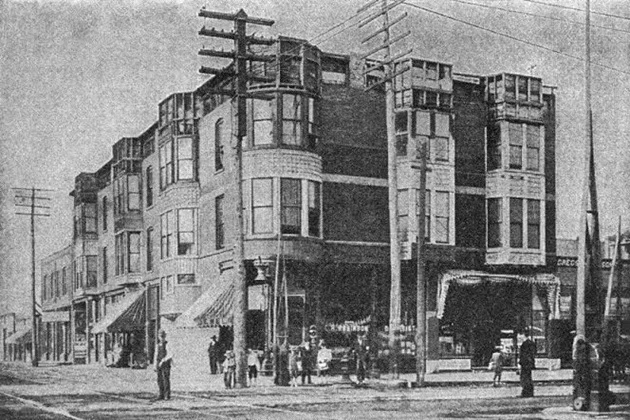
H. H. Holmes is considered the first American serial killer, and his story really looks like a movie script. Henry didn’t look for his victims in the back streets, didn’t get drunk in bars, or pick them up on freeways that didn’t exist back then. In 1893, Holmes commissioned the construction of a three-story hotel in downtown Chicago, near the World’s Fair. It was a devilish genius. Wealthy guests from the USA and Europe themselves fell into the hands of a maniac, and they also paid for it.
Externally, the hotel looked like an ordinary building, but the layout was a real maze. Some of the doors didn’t lead anywhere, and there were short and dead-end corridors behind them. Some of the “rooms” had no windows at all, while others had secret passageways. To avoid attracting too much attention, Holmes hired several construction crews. Thus, no one in the world knew the complete plan of the building.
According to the press of the late 19th century, the “Castle of Murders” had special soundproof rooms. On the second floor, there was a chute that descended directly into the basement. The dark dungeon housed a torture room and an acid tank. Mr. Holmes was disposing of the bodies there. The exact number of victims is unknown — usually, several dozen are mentioned. After the arrest and execution of Henry Howard Holmes in 1896, the Murder Castle was set on fire, but the building survived and was partially used as a post office for the next forty years.
2. Bunkers of the Colonia Dignidad
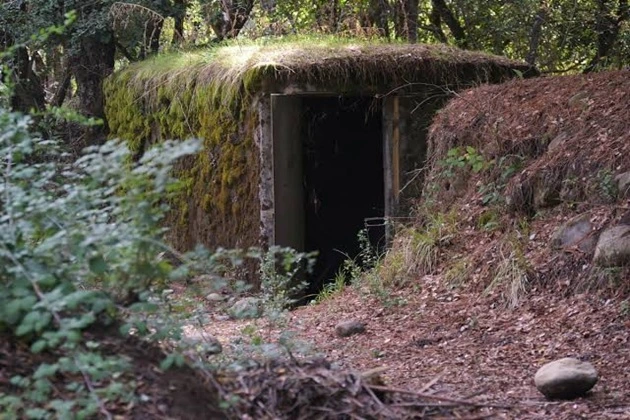
Dignidad is a settlement in the foothills of the Chilean Andes. An agricultural colony founded by Nazis who fled after the fall of Berlin. The seemingly prosperous commune was in fact a labor camp, where any disobedience was severely punished. Actually, what else could you expect from the functionaries of the Third Reich? In the mid-1970s, a military junta led by Augusto Pinochet came to power in Chile. The former Nazis were somewhat pacified, however, as were all other political forces. The dictatorship does not tolerate competition.
The former colony of Dignidad was given over to the needs of the special services. They immediately started digging the ground — not for growing crops, of course. A network of underground bunkers was placed in a place with a scandalous reputation, where opponents of the regime were kept. It turned out to be a kind of matryoshka doll, double insulation. Visit. A F R I N I K . C O M. For the full article. The scale of the construction became known only in the late 1990s, when it was time to condemn the Pinochet regime. According to the found logs, thousands of people passed through the bunkers. Most of them were never found.
3. The dome of Runit Island
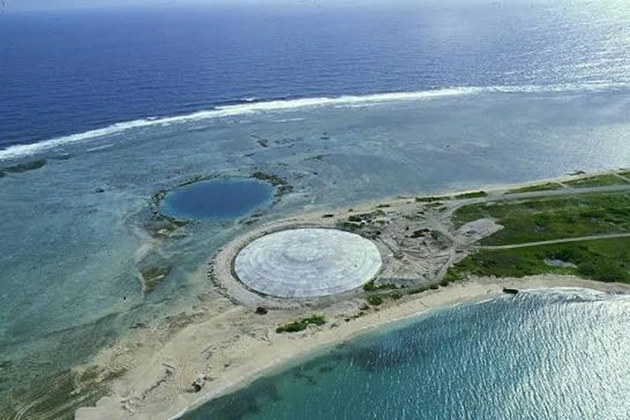
Runit is part of the Republic of the Marshall Islands, which gained independence from the United States only in 1986. There are about 1,200 islands in the Pacific state, but only one of them has a remarkable dome. There is an impressive crater under the massive concrete structure. These are the traces of nuclear tests that have been carried out here for twelve years. That’s how dozens of bombs were dropped on a truly paradisiacal corner of the planet.
In the late 1960s, the Americans collected radioactive waste, machinery, and contaminated soil, and then buried it all on Runit Island. Currently, there are about 70,000 cubic meters of contaminated waste under the dome. It would be possible to forget about it, but the design is old and rather primitive. First of all, there is no concrete or any other floor. That is, radioactive waste lies on porous corals. Secondly, rising ocean levels threaten to depressurize the sarcophagus.
This will happen sooner or later, of course, if you do not take measures in advance. Access to Runit Island is not controlled by the Government in any way. However, this place is really as far away from everything as possible. For a tourist, it will be a very expensive trip with questionable pleasure. There is no infrastructure nearby.
4. Valley of the Fallen
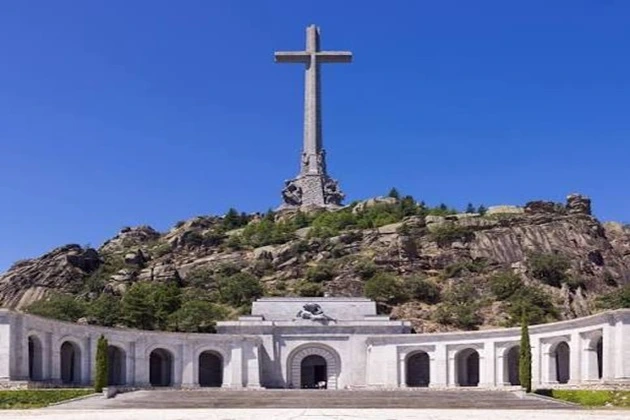
Not far from Madrid, there is a monumental complex, founded by decree of Francisco Franco in 1940. The Valley of the Fallen was intended to become a symbol of national reconciliation after the Spanish Civil War. The main element is a 152-meter-high cross towering over the terrain. The object is impressive, and the idea is also good, but there’s a pretty dark story behind it all. Who built all this? Naturally, the losing side is the captured Republicans, who were later joined by political prisoners. The construction took almost twenty years, and who knows how many more people died during that time.
The work is hard, the ration is light. Everything is as usual, such a “reconciliation”. After the construction was completed, the remains of 34,000 Civil War veterans were moved to the territory, where they found their last resting place. Many of the soldiers were never identified. However, the complex fulfills its role by preserving historical memory. The Silent Valley of the Fallen warns against accepting new “reconciled ones.”
5. Busan Olympic Park
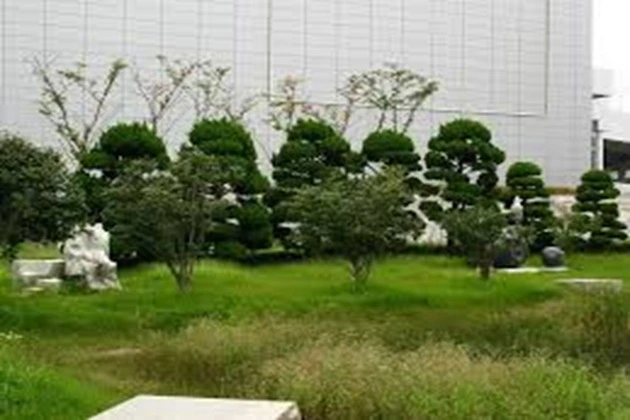
Before the 1988 Olympic Games, large-scale construction projects were launched throughout South Korea. The country had to conform to the image of victorious capitalism, to look attractive and successful in the eyes of numerous tourists. Most of the work turned out to be in Seoul, where it was planned to hold most of the competition. This was hindered by huge slums inhabited by the homeless, the unemployed, the disabled, and other vulnerable segments of the population.
The people were evicted in just a few days, moving them to the “Brothers’ House”, which was located in Busan. Theoretically, it was a shelter, practically a concentration camp, where forced labor was used. The figure of 657 speaks eloquently about the general living conditions. So many people died in the Brothers’ House in a few months. The most monstrous force in this story is the corrupt police. The owners of the shelter, who extracted a lot of money from the free labor force, found common ground with the law’s fears. New guests began to be caught now on the streets of Busan.
They were completely random people, often children and women, who were easily intimidated. There is still an active group of people in South Korea who have passed through the “House of Brothers”. People demand compensation and responsibility for those involved. The government acknowledged the problem, but no one was punished or received any payments. A beautiful park was created on the site of the camp. There are no mentions, memorials, or commemorative plaques.