The great sphinx mystery: Who was its model and what secrets does it hide?
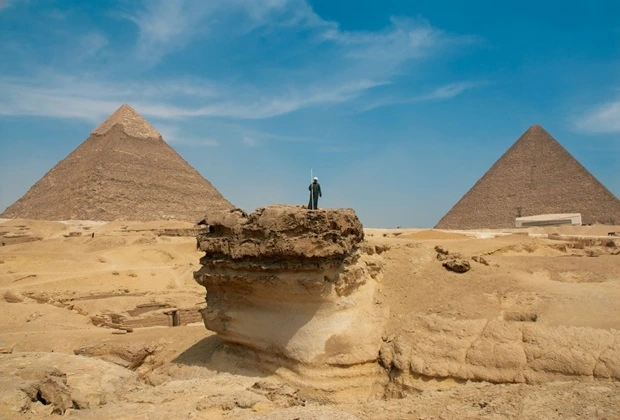
On the Giza plateau, next to the pyramids, stands a figure that raises more questions than answers. The length is 73 meters, and the height is 20 meters. The face of a man. The body of a lion. The gaze is directed into the distance. It is unknown who created it, when, and for what purpose. Even the ancient Egyptians, with their papyri and drawings, did not mention him in the text related to the construction of the pyramid of Khafre. Although the statue is traditionally considered to have been created at the same time.
Why are the ancients silent
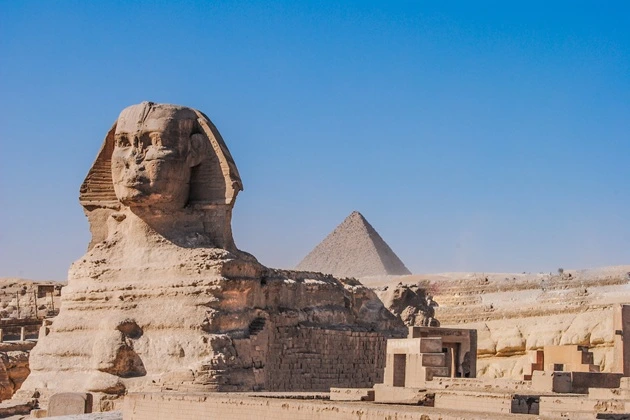
The Greek historian Herodotus, who described Egypt in detail in the 5th century BC, did not write about the Sphinx. Why? Was it because he couldn’t be seen? The Roman scientist Pliny the Elder said that sometimes the Sphinx was completely covered with sand. Until the 20th century, archaeologists periodically excavated it when it was completely covered with a layer of hot sand. Travelers who came to Egypt dreamed of seeing this wonder of the world. But instead, we saw huge dunes. All that remained was to imagine that beneath them was a face that had been looking at the world for thousands of years.
There is an official version: The Sphinx was built around 2500 BC, during the time of Pharaoh Khafre. But there are those who believe that this is impossible. Japanese researchers conducted an ultrasound scan of the giant in the 90s. The result was surprising: the stones of the statue were processed much earlier than the famous blocks of the pyramid of Pharaoh. That is, according to these data, the statue is older than the pyramid itself.
And also — water. Deep vertical furrows are noted on the body of the Sphinx. They’re not from the wind. Not from the sand. They are rain trails. Abundant, long-lasting, powerful. The kind that marched in the Sahara Desert many thousands of years ago. When she was green. When the rivers flowed there. When people lived not in the desert, but in gardens. British hydrologists have confirmed that these traces are not from the modern climate. They point to an era when the Sahara was wet. This means that the age of the Sphinx can reach 12 thousand years. Before the Flood. Before the climate changed. Before a person became who they are. If the Sphinx is older than we think, it means that the civilization that created it was also older.
He’s sick because of people
Arab philosophers called him immortal, unaffected by time. They were wrong. The Sphinx gets sick from time to time because of the weather and people. The Mamluks were damaging him. The Napoleonic soldiers had fun using it as a target. For some reason, the locals deprived him of his nose, and the British took away his beard as a trophy. They took me to London. In 1988, a block weighing 350 kg fell away from the Sphinx. And it happened because of a bad restoration.
Previously, they tried to seal up the cracks with cement. It was a mistake. The cement absorbed moisture. The stone began to collapse from the inside. And also — car exhaust, smoke from factories, acid precipitation. Visit. A F R I N I K. C O M . For the full article. UNESCO has assembled an international commission. Their conclusion: The Sphinx is in critical condition. Hundreds of millions of euros are needed for a complete restoration. But Egypt doesn’t have them. The work is going on, but slowly.
Whose face does the Sphinx have
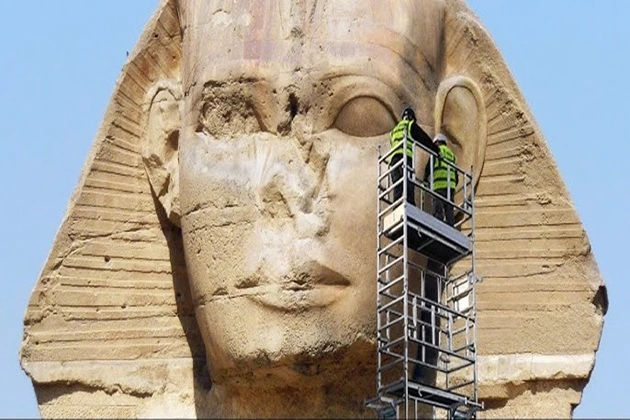
Egyptologists are sure: this is Khafren, the sixth Dynasty. But there is a problem —there is no connection between the Pharaoh and the Sphinx. No labels. No drawings. No mention of it. Only guesses and legends. Dr. I. Edwards (chief expert on Giza) says that even after millennia, you can see the features of Khafre. But here’s the interesting thing: the Pharaoh’s body was never found. For comparison, we took his statue from the Cairo Museum. Frank Domingo, a portrait cop from New York, was invited. For many years, he was talented at drawing faces based on eyewitness descriptions of crimes. He compared the two images and concluded that they were of two different people. So either the Sphinx is not Khafre. Either Khafre is not who they think he is.
A new assumption about the secrets of the Sphinx
Egyptian archaeologist Ash-Shamaa has proposed another fascinating hypothesis. He believes that the known part of the Sphinx must have a “sister” hidden under a thick layer of sand. The “Father of Fear” (as the giant is called) cannot exist alone. According to Al-Shamaa, the “Mother of Fear” should correspond to him. This thought did not arise out of nowhere. The ancient Egyptians deeply revered the principle of pairing. They rarely created single monuments. Wherever there was a man, there was necessarily his twin incarnation, that is, a woman.
The area around the Sphinx rises several meters above it. This, according to the Egyptian researcher, is not an accident. It is there, under the desert sands, that the “Mother of Fear” lurks. Other facts indirectly confirm Al-Shamaa’s guesses. A stele depicting two statues was discovered near the Sphinx. A plaque is attached to the granite base, which says that one statue was destroyed by lightning.
The Mysterious Room
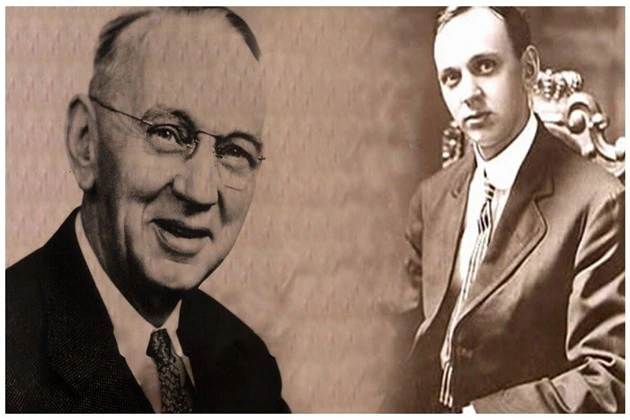
The most ancient Egyptian treatise on the gods contains an amazing story. It is narrated by the great goddess Isis herself. She says that He sent his sacred books to some secret place. To protect the great knowledge from the unworthy, He put a spell on the room. Wisdom will be waiting for those who deserve it. Some Egyptologists still believe that the cache exists. The words of the soothsayer Edgar Cayce about the “Hall of Testimony” are often recalled. This hall, in his opinion, hides under the paw of the Sphinx. There is a theory that there may be unique information about an ancient civilization. Perhaps the one who ruled the planet many thousands of years ago.
An interesting discovery was made in 1989. Scientists from Japan have found a tunnel. It led from the Sphinx to the pyramid. A chamber was also found to the northwest of the queen’s burial chamber. The Japanese were not allowed to complete the study. The Egyptian authorities have imposed a ban. In 1993, American geologist Dobecki found a rectangular space. It was of considerable size and was located under the paws of the Sphinx. The Egyptian authorities also prevented the research from being completed. Since then, the Egyptian government has banned any excavations around the Sphinx. And who knows what other secrets the ancient statue holds.