How the dance plague devastated Europe, and what caused the crazy dancing
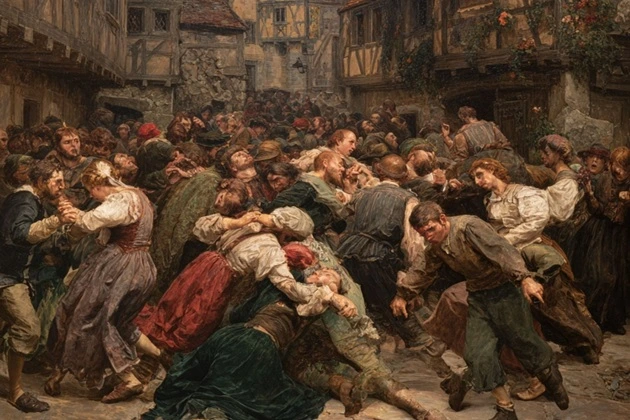
In the sixteenth century, an incomprehensible epidemic occurred in Europe, known in history as the “dancing plague.” Suddenly, under the influence of unknown forces, people started dancing, exhausting themselves to death. Such stories seem to be fiction. But the facts about this mysterious disease are confirmed by documents and drawings of contemporaries. But what gave rise to this outlandish death dance? And how did they find justice for her?
It’s all Frau Troffea’s fault
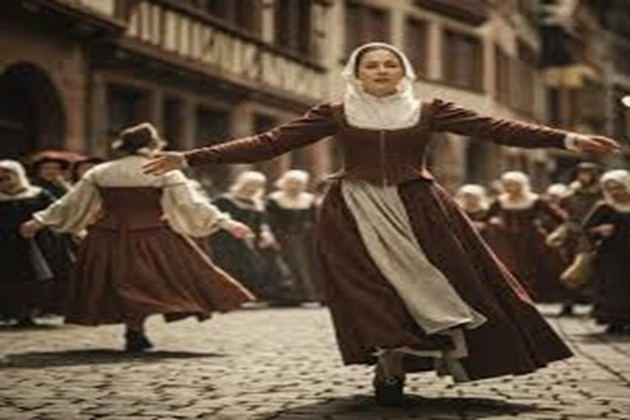
It all started in Strasbourg, with a woman named Troffea. In the middle of summer, in July 1518, she left her home to do some shopping. They say she needed flour for the pie. Once in the town square, she suddenly stopped, as if bewitched. Her body was shaking, distorted by convulsions, and her face expressed a strange agony. Those who tried to help her were instantly involved in this crazy action, as if an invisible net was pulling them into a dance. However, the movements bore little resemblance to an ordinary dance.
Rather, they were agonizing convulsions, uncontrollable flapping of arms and legs. At the same time, no one could stop. An unknown force was dragging people into the dance of death. In just a few days, Strasbourg was invaded by the disease. Dozens of people joined the dancing woman. A month later, the number of dancers reached four hundred. Troffea was the first to be captured by this strange dance: she could not stand a week of continuous dancing and died. Exhausted, with bloody feet, the townspeople continued to dance until they fell to the ground dead. Medical methods proved powerless. Nothing worked. Madness gripped the city. The mysterious disease was spreading.
How they tried to stop the epidemic
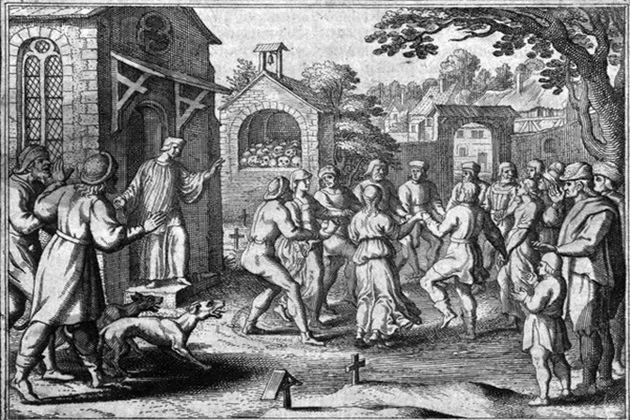
Many dance-obsessed people were brought to one of the monasteries. They were tied to their beds. Heavy shoes were put on their feet. All to stop dancing. One of the most common methods was to immobilize dancers by swaddling. The victims were wrapped in cloth like babies. Some of the sufferers claimed that the tightening of the abdomen made the condition easier. There were even cases when they asked for a punch in the stomach to calm the dancer. But in vain, people continued to die. This is the story of art critic Maria Ehrlich.
The rulers came to the conclusion that the disease would subside if the townspeople were allowed to vent their energy by dancing. A wooden platform was erected in the shopping area, where musicians played tirelessly. The rest of the townspeople were carefully protected from the sick. But the hopes were not fulfilled: people continued to die of exhaustion. Although the doctors rejected the mystical reasons, it was decided to hold religious ceremonies and ban all kinds of entertainment (including music, dancing, cards, and corrupt love). The inhabitants of Strasbourg revered “Saint Vitus”. They believed that dancing in front of his image would bring relief from diseases. At the same time, there was a belief that Whit could send dancing, leading to exhaustion. This belief only increased the fear and panic.
Soon, the epidemic began to decline. It claimed the lives, according to various estimates, of between three hundred and six hundred people. But the real cause of this strange disease has remained unsolved. Three months later, the dancing plague left Strasbourg as suddenly as it had come. But it was a temporary phenomenon. In the following century, a strange disease spread throughout Western Europe. Often, the first outbreak began during a long church service. In dark and stuffy temples, impressionable people suffered from hallucinations and seizures. The fear that gripped a person was instantly transmitted to others. And soon the crowd was drowning in a frenzied dance.
So what really happened?
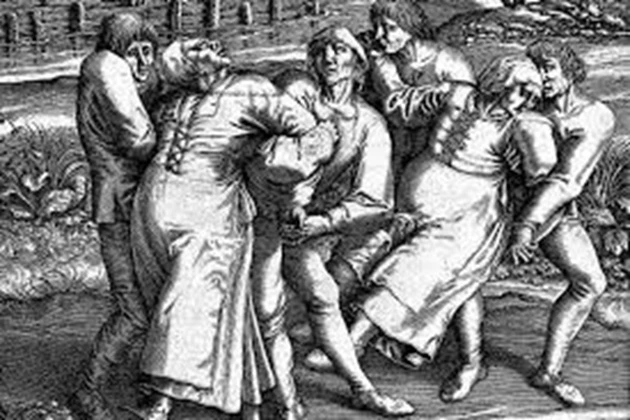
What was the reason for the dancing plague in Strasbourg? The famous physician and alchemist Paracelsus came to Strasbourg in 1526. That is, shortly after the tragic events. It was he who first mentioned Frau Troffea in his writings. He coined the term “choreomania” to describe a strange disease. Paracelsus had his own idea of the origin of the dancing plague. It turned out that Troffea’s husband couldn’t stand her dancing. Paracelsus and some of the townspeople believed that the woman started dancing just to annoy her spouse.
Paracelsus identified three sources of dance sickness. Firstly, it was caused by imaginary reasons. That is, an inflamed brain. Secondly, some people could join the dance because they suffered from sexual dissatisfaction. Finally, individuals could have their own physiological reasons. Ultimately, Paracelsus blamed the dancing plague on unhappy wives.
According to historians, the cause is poisoning caused by ergot. That is, a fungus that affects cereals. At that time, rye and wheat were the basic foods of Europeans. In the Middle Ages, no one fought with this fungus. It was called the “mother of rye,” and its distribution was quite wide, especially in Western Europe, where the poison was easily ingested. Psychiatrist Vladimir Fainzilberg expresses this opinion.
Ergot contains toxic substances. They affect the nervous system and lead to hallucinations. They also cause unbearable burning in the hands and feet, and sometimes gangrene. It is not for nothing that this disease was called witches’ writhe and St. Anthony’s fire.
There are also less likely explanations provided by modern science. For example, epilepsy. There are suggestions that the “dancing plague” could be caused by a rare form of this disease. However, epilepsy is not transmitted from person to person. Visit. A F R I N I K . C O M . For the full article. And in most cases, it is caused by genetic factors. If epilepsy were really rampant in Strasbourg, the city would be filled with people falling, not dancing.
Another option is religious ecstasy. In those days, people believed that dancing would scare away St. Vitus, the patron saint of epileptics and dancers. Perhaps it was the saint who inspired these dances? Unlikely. Or maybe it was mass hysteria. Chronic malnutrition, fear, and continuous stress create ideal conditions for mass psychosis. Perhaps collective hysteria became the background for psychosis, rather than its cause. Fortunately, people are unlikely to be in such danger today. And it’s better to dance in nightclubs and dance schools.