Ancient pathways: The earliest roads ever built and their modern remains
What are roads like? The question may be confusing. A flat surface, fenced with curbs and covered with asphalt. In any case, this is the case in large cities. Gravel is often used in rural areas, but there are roads made of simple rolled earth. There is no single standard, but these transport arteries necessarily lead from point “A” to point “B”.
This has always been the case, even in ancient times. Roads seem to be unpretentious structures.
However, as soon as a person leaves the area, nature immediately goes on the offensive. The asphalt is covered with cracks through which the grass breaks through. Heavy rainfall, direct sunlight, and strong winds first turn the once-wide road into a barely noticeable path.
After that, it disappears completely into the surrounding landscape. Sometimes archaeologists manage to excavate such roads, and several additional discoveries always accompany this. Visit . A F R I N I K . C O M . For the full article. Scientists can only follow the indicated direction, following the footsteps of the past civilization, which were left centuries and even millennia ago.
Ur Road (Mesopotamia, 4,000 BC)

This is the road of one of the oldest cities in the Ur world, which has been used for several thousand years. Naturally, it has been rebuilt several times over such a long period of operation. However, according to radioisotope analysis, the age of the oldest stones in the masonry is estimated at almost 6,000 years. In 2047 BC, the Etemenanki ziggurat was erected in the city, then the existing road gained special significance. It ran in a straight line from the walls to the temple complex. Modern historians call it the “Road to Heaven.”
The ruler and his immediate entourage were moving through the entire city. Having reached the Great Ziggurat, having overcome several dozen more steps, they literally towered over the rest of the inhabitants and all other buildings. During its existence, Ur has experienced decline and rise several times. Today, it is a ruin covered with sand. But try to imagine how many people have walked this road, and how many extraordinary stories these stones have seen.
Sweet Track (England, 3,800 BC)

Right now, before your eyes, is the oldest preserved paved road in the world. It is named after its discoverer, Ray Sweet. However, the enterprising man hoped to find peat reserves, for which he organized an expedition to a swampy area. Actually, thanks to the marshes, part of the wood was preserved, with the help of which helped establish a fairly accurate age. The margin of error may be as little as 150 years.
Further research showed that a road with a length of just over 2,000 meters once connected a pile settlement on the now-extinct Westhay Island with the nearest hill, where traces of a Neolithic site of ancient people were also found. Exploring the road meter by meter, the archaeologists found many artifacts, from pottery fragments to a whole and relatively well—preserved jade axe. Today, the road has been reconstructed for tourists; the original elements are in the museum.
The Royal Road (Achaemenid Empire, 500 BC)
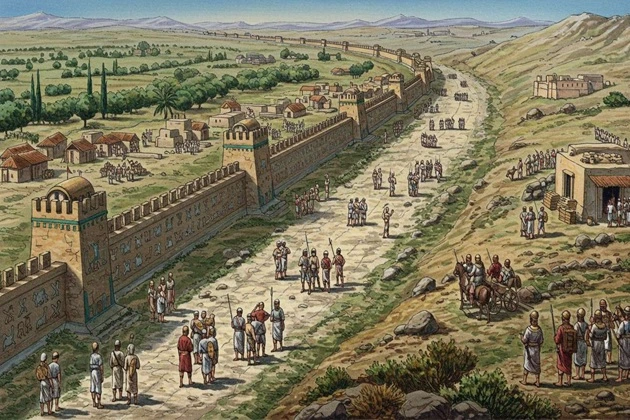
Strictly speaking, all the ancient roads will be located in Mesopotamia. After all, that’s where the first civilizations originated. So we’ll skip a couple thousand years to get a look at something really impressive. The “Royal Road” became known thanks to the writings of Herodotus. The “Father of History” reports that its construction was carried out during the reign of Tsar Darius I, that is, at the peak of the empire’s power.
A two—lane paved road crossed the whole of Persia, from the capital at Susa to the Aegean Sea. 2,699 kilometers of continuous roadbed. Along the entire route, the ancient Persians built 111 stops where travelers could rest, replenish supplies, and change horses. Thousands of people were employed in infrastructure maintenance. We are talking about garbage collectors, security guards, and postal service workers. After the fall of the Achaemenid Empire, the road was used for a long time by all conquerors, including the Romans. Today, many fragments of the “Royal Road” still exist and are open to tourists.
Roman Roads (Roman Republic, 350 BC)
Throughout history, the Roman Republic (and later the Empire) pursued an expansionist policy. She carried the light of civilization and humanism, naturally, with fire and sword. Roman settlements immediately appeared in the conquered or voluntarily annexed territories, and in a matter of years, roads were stretched to them. Thus, at the time of its peak, the total length of Rome’s internal trade routes was estimated at 400,000 kilometers.
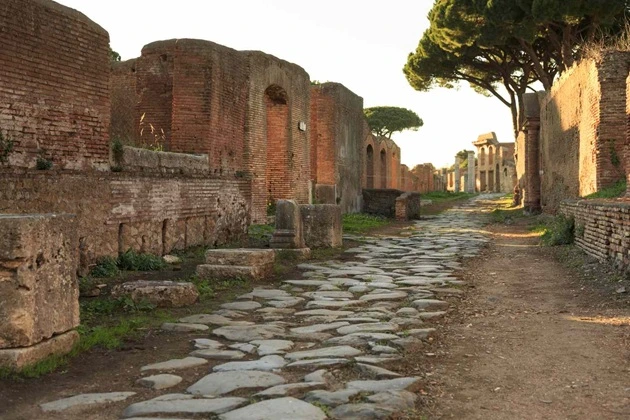
In peacetime, merchants traveled along these roads, offering food and other goods. During the war, the network was used to move legions quickly. Many Roman roads, especially in small towns, are still in use today. Stone slabs laid more than two thousand years ago still perform their function. Some sections and directions turned out to be so well laid out that modern asphalt was simply laid on top.
The roads of Derbent

Due to geographical features, roads 5-6 thousand years old have not been preserved in our country. However, there are some interesting examples. Derbent is one of the oldest cities in Russia, occupying a strategically important position and being a kind of gateway between the Caucasus and the Caspian Sea. The first fortifications appeared here in 479. Over the next centuries, this land saw a huge number of armed clashes. The fortress, located at the foot of a mountain range, gradually grew into a real city with a market, a port, a square, and hundreds of houses. Of course, there are roads here that still exist today. Derbent is located in the South of Russia in the Republic of Dagestan.
It is a relatively popular tourist destination. Close to the sea, mountains, and many historical attractions. Local guides will tell the incredible stories of their ancestors, but one of the main features is out of sight of most tourists. We are talking about the old streets located closer to the city center. The stone slabs in some corners are older than Russia itself. Their age is estimated at one and a half thousand years, and ordinary people walk on them, as before.