
Earth’s most alien-looking landscapes
We have photos of Mars, the Moon, and even a few images from Venus. However, when talking about other planets, you can’t help but imagine something more intense. Not endless and monotonous landscapes, where there are only rocks and rare mountains. Imagination, trained by fantasy films and games, sets very different standards of quality. Diversity is required, not only of landscapes, but also of life. To some extent, the desire to see alien worlds can be satisfied without flying into space. There are plenty of places on Earth where climate, geology, and evolution itself have decided to conduct their experiments.
The Danakil depression
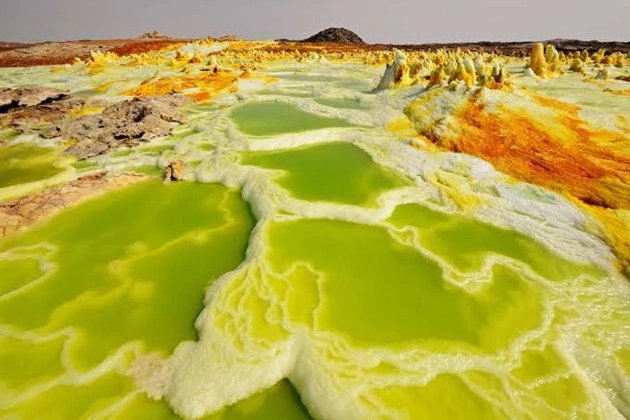
There is a point in northeastern Ethiopia where the African, Somali, and Arabian tectonic plates converge. In this area, the Earth’s crust is spreading in different directions. It is here that the border of the new sea will pass through millions of years. One of the most unusual volcanoes on the planet, Dallol, rises above the depression. Instead of lava flows, acid, sulfur, and salt deposits flow out of it. Nearby reservoirs acquire the appropriate color: yellow rivers, bright green and turquoise lakes. It’s a dead place for a human. The water is poisoned, and there are only rare shrubs among the vegetation. However, it is a great environment for extremophiles. This is the name given to microorganisms capable of living in the most unfavorable conditions. Studying bacteria from the Danakil depression helps to understand what forms of life we can find on Mars, as well as on the moons of Saturn and Jupiter.
Socotra
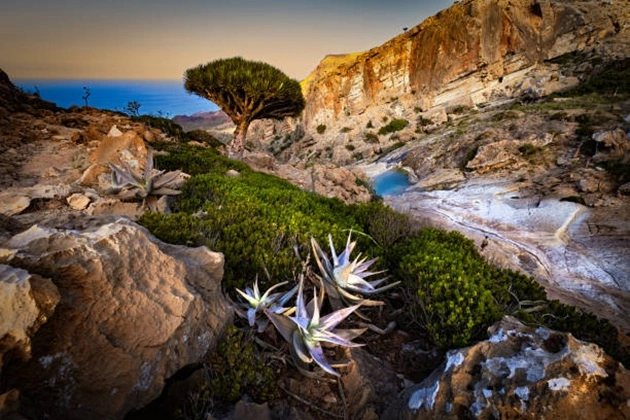
We move to the ocean, or rather, to the island of Socotra. Today, the entire archipelago belongs to Yemen, but geology and biology point to a close connection with Africa. Millions of years ago, this land area split off from the continent and continues to “drift” towards India. Of the nearly 800 plant species, one third is found nowhere else in the world. The main symbol of Socotra is the Dragon Tree. It looks like a set from a fantasy movie: a huge inverted mushroom. A red resin stands out from under the bark, which has an equally eloquent name: “dragon’s blood”.
The Bottle Tree looks no less impressive. A disproportionately thick trunk allows it to accumulate moisture and survive a prolonged drought. During the flowering period, large pink flowers open on rare branches. Due to poor logistics, there is no mass tourism here, which allowed nature to remain in such an unusual form. Visit. A F R I N I K . C O M . For the full article. Since 2008, the Socotra Archipelago has been included in the UNESCO World Heritage List.
Wadi Rum
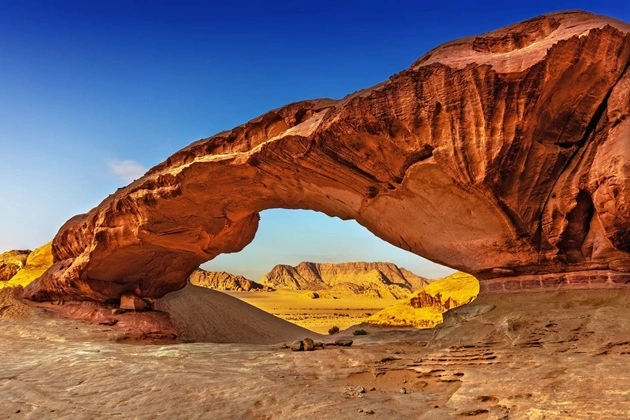
You know this place pretty well, even though you’ve never been there. Such films as “Star Wars”, “The Martian”, “Dune”, “Prometheus”, and “Red Planet” were shot in Jordan’s “Moon Valley”. For decades, Wadi Rum has served as a natural setting for shooting fantasy films. A relatively small desert area surrounded by granite massifs hundreds of meters high. Natural bridges and arches, narrow canyons, and red-orange shades of rock make it possible to shoot without any additional filters or computer graphics.
The main “Mars” on Earth has been created for millions of years. The name of the master is well known: the wind. However, judging by the petroglyphs found, despite the harsh climate, people periodically inhabited the region. Today, almost all the small local population is somehow connected with the sphere of tourism and film production.
Salar de Uyuni
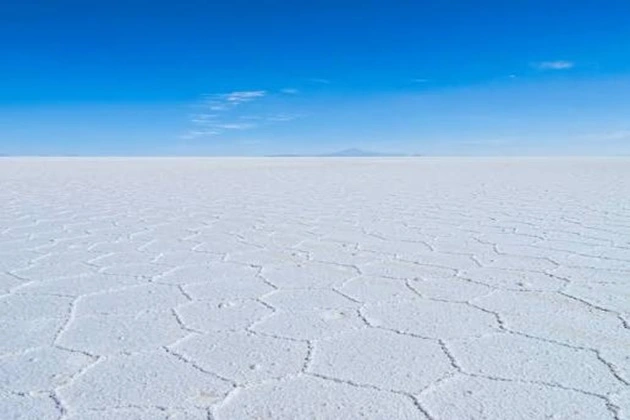
South America, Bolivia, is a place where the horizon disappears, and the sky merges with the earth. After heavy rain, the world’s largest salt marsh turns into a huge mirror. It’s not a figure of speech. From a well-chosen angle, it will seem that a person is walking on clouds. If you look at some of the images, the first thought that comes to mind is “Photoshop.” Indeed, it is impossible to see anything like this in everyday life. The mind, which has not had such an experience, simply refuses to believe in the reality of the painting. Once upon a time, there was an ancient lake on a high-altitude plateau.
The climate was gradually changing, so the water evaporated. Only salt deposits remained on the flat surface. The thickness of the crust reached several meters. The most valuable thing is stored under it: huge reserves of lithium, discovered only at the end of the 20th century. On the one hand, it is a new strategic resource of the country; on the other, a prerequisite for the disappearance of the amazing composition created by nature.
Lençóis Maranhenses
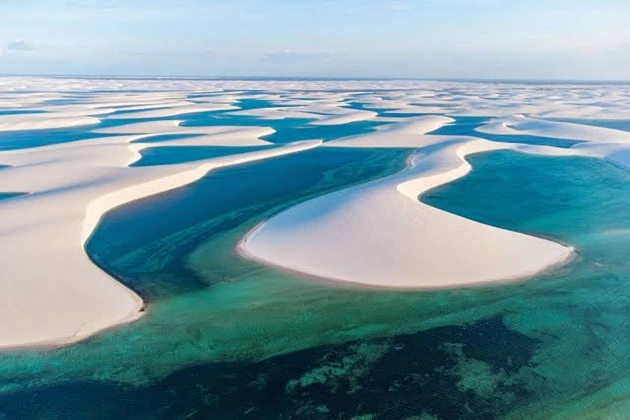
It could be an ordinary desert with snow-white dunes that stretch to the horizon. There is not a single tree around, but it is worth walking a few kilometers, as any traveler notices the strangeness. Everywhere there are bright blue, sometimes emerald lakes. There are hundreds, if not thousands of them, and this is not a mirage, not an illusion. Strictly speaking, the Brazilian Lens Maranhenses (Maranhense Sheet) is not considered a desert. There is a lot of precipitation in the region. Actually, hence the abundance of lakes right in the middle of the dunes. Perhaps it is the sand that is an alien element here. The Amazon and other rivers flowing into the Atlantic Ocean bring a lot of sand. Then the ocean currents throw it onto the land. Then the wind takes over, increasing the area of desertification.
Yellowstone National Park
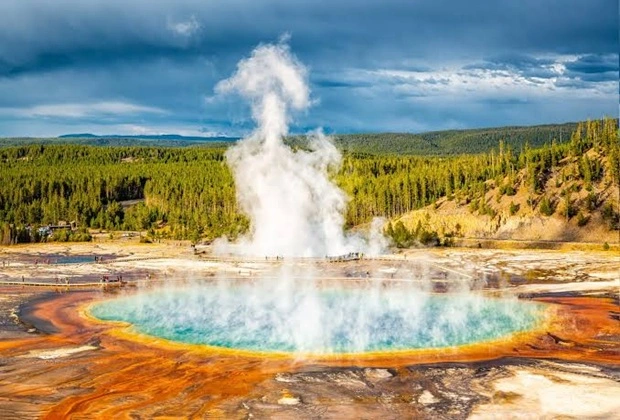
Yellowstone is the first national park in the world, opened back in 1872. It has been constantly expanding and now occupies a huge area (almost 9,000 square kilometers) on the territory of three states. This is more than some countries. The main attraction is the supervolcano of the same name. Actually, the park itself is located above a colossal magma chamber. Temperature and pressure have created thousands of geothermal vents, which were once not only a source of heat, but also a primitive cuisine for local tribes. Yellowstone is home to half of all the geysers on the planet, the most famous of which is the “Old Lifer”. It’s not about size, color, or any other visual feature.
This geyser erupts at fairly predictable intervals, which attracts tens of thousands of tourists annually. Contrary to popular belief, there is no serious reason to believe that the volcano will wake up soon. Scientists are constantly checking the activity, and so far there have been no signs of an impending disaster. However, if this happens, it will be a catastrophe on a global scale. If we talk only about the United States, then the ash will partially or completely cover 11 states, affecting even Canada.