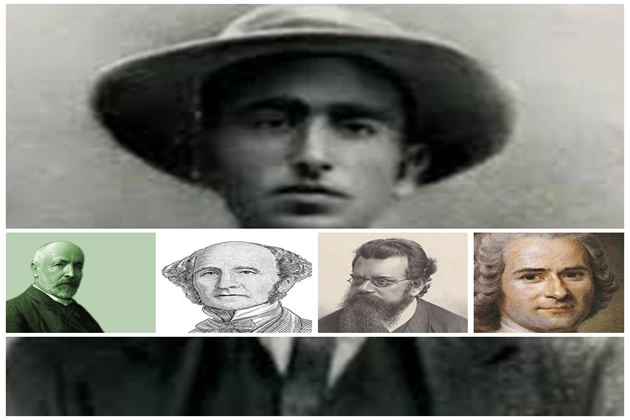
We call philosophers people whose ideas are aimed at expanding the boundaries of thought. They ask questions that no one else in the world has the answers to. Therefore, you have to find the solution to the riddles yourself. Most often, this leads to arguments about something abstract, inaccessible, and not particularly important to most of us. However, sometimes such ideas turned into a real nightmare, driving the best thinkers to the extreme.
5 philosophers whose theories led them to the edge
1. Carlo Michelstaedter
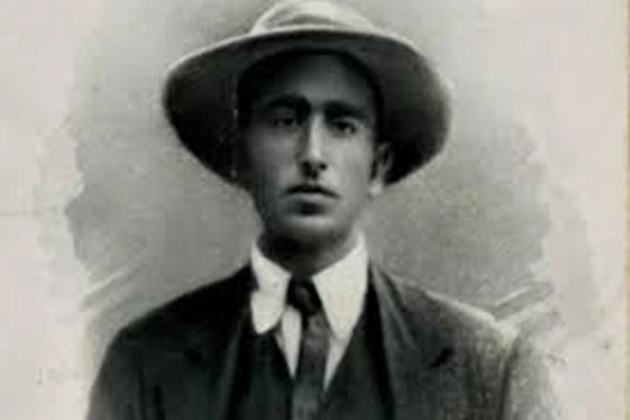
The Italian philosopher and poet believed that almost all people live in insincerity and falsehood. Here and there, we rely on the external environment, seek encouragement from outside, and use routine to distract ourselves from significant things. Carlo Michelstaedter called such an existence the denial of death and the fear of facing the absurdity of life.
The basis of Michelstaedter’s philosophy was complete self-sufficiency, which is achieved by rejecting illusions, including personal and therefore subjective values. The idea raises a lot of questions. For example, what kind of value is a person’s life? According to the philosopher, even hope is a rhetorical device by which we engage in self-deception. Carlo demanded such absolute clarity of thought.
His only major work, Persuasion and Rhetoric, was completed in 1910. On the same day, the young man loaded a revolver and put a bullet in his chest. Visit. A F R I N I K . C O M . For the full article. Today, the philosopher’s work is called a manifesto of humility, adopted on the edge of emptiness.
2. Georg Cantor
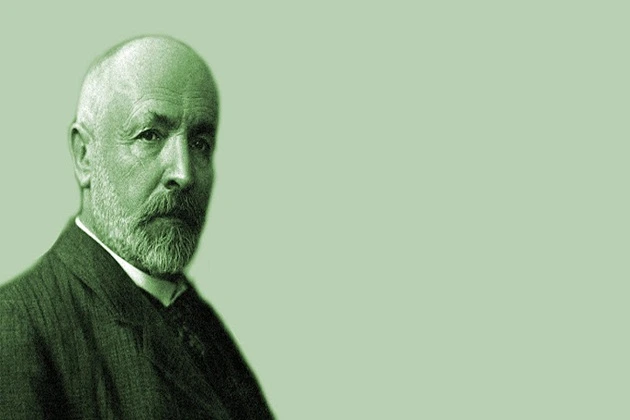
The German thinker Georg Cantor is known for his thirst for knowledge of infinity. His philosophical and mathematical works caused fierce controversy. The peak of his career can be considered the “theory of sets”, put forward at the end of the 19th century. The point was that some infinities are bigger than others. The idea challenged traditional notions of quantity.
The concept was supported by the following argument: the set of rational numbers is infinite, but countable, whereas the set of real numbers is infinitely uncountable. Thus, different types of infinities were derived, which allowed us to speculate about their power or hierarchy. This position contradicted intuition and provoked resistance from academic science. Many prominent mathematicians of the time ridiculed Cantor, calling him a charlatan.
This played an important role in the further transformations of the thinker. The attacks began to be perceived as confirmation of God’s choice. He (Georg Cantor) was chosen to reveal the nature of infinity. In his diary, the mathematician compared his discoveries with a divine revelation.
Acquaintances noted that in recent years Kantor had been in limbo, where increasingly rare moments of clarity were replaced by frankly delusional thoughts. Incoherent theological arguments were increasingly added to mathematical formulas. Georg Cantor died in a psychiatric hospital, tormented by thoughts of infinity. Today, Kantor’s works are the basis for many branches of mathematics.
3. John Stuart Mill
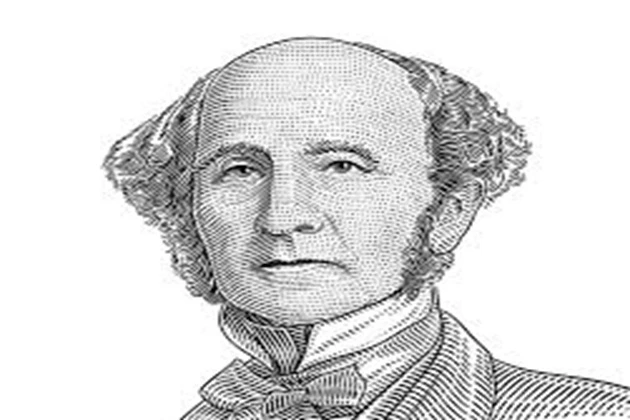
John Stuart Mill’s utilitarian views suggested that emotions and morality itself should be based on the principle of the good for the greatest number of people. The minority was supposed to be ignored. Probably, this was facilitated by an imperfect human upbringing. Instead of the usual childhood filled with games and fun, Mill studied Greek, Latin, logic, history, and economics every day.
By the age of eight, he could read and, most importantly, understand the works of Plato, and at 12, he mastered political economy. I had to pay for a brilliant education with low emotional development. Human feelings such as grief, boredom, and delight were perceived as variables that needed to be optimized or ignored altogether. Mill suffered severe mental breakdowns several times. In the end, he found that he was unable to enjoy anything.
The philosopher had a legitimate question: Is universal happiness possible at all if he, who so masterfully controls emotions, does not feel anything like this? According to Mill, at some point, his world collapsed. Trying to reduce morality and ethics to a mathematical formula, John Stuart Mill came to the poetry of Wordsworth, which glorified a life filled with uncontrollable emotions. An oversaturated mind and a starving heart led the philosopher to confusion and complete disillusionment with his ideas.
4. Ludwig Boltzmann
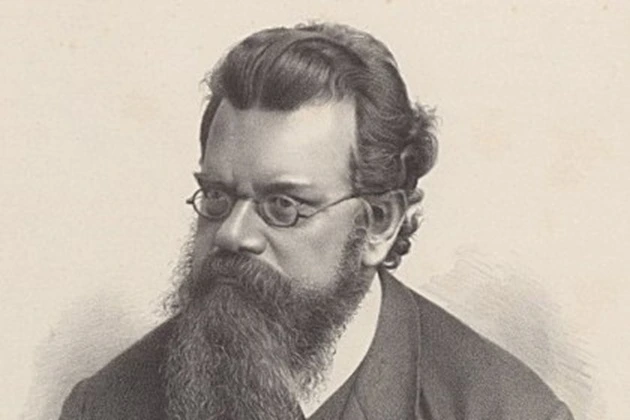
Ludwig Boltzmann always called himself a physicist, but his ideas were ahead of their time, so many colleagues considered them more philosophical. What if the order in the universe and the laws of physics are explained not by statistical mechanics, but by the chaotic motion of countless atoms? It is worth noting that the very existence of atoms had not yet been proven at that time and was perceived as another pseudoscientific hypothesis, little different from the divine creation of the world.
Boltzmann introduced the concept of entropy, according to which all natural systems evolve from order to chaos. It turned out that we live in an unstable and infinite universe. Moreover, there is an irreversible movement towards heat death. That is, the energy in the universe will be distributed in such a way that no interactions (even at the atomic level) will be possible. You’ve probably noticed a lot of familiar terms and definitions.
Today, all cosmology is based on ideas put forward by Ludwig Boltzmann in the 19th century. However, his contemporaries were not ready for a revolution in physics and fiercely opposed the thinker. Against the background of endless attacks, Boltzmann developed chronic depression, which ended in tragedy in 1906. During a vacation in Italy, a physicist took his own life in a hotel room. Just a few years later, the existence of atoms was proven. Now the entropy formula (S = k log W) is stamped on his tombstone.
5. Jean-Jacques Rousseau
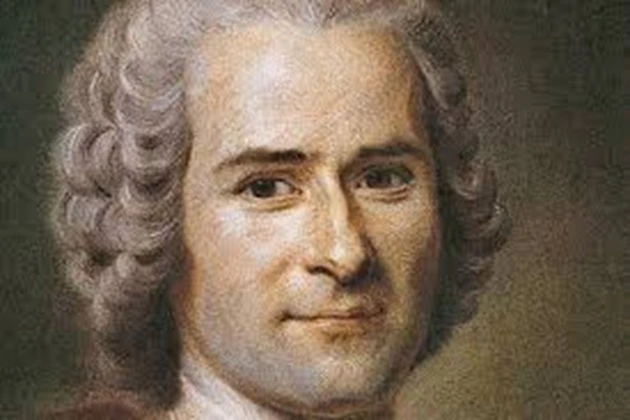
The concept of “collective will” became one of the most controversial ideas in the Enlightenment era. According to Rousseau, society should be governed not by kings or influential groups of people, but by the will of the people, aimed at achieving the common good. The revolutionary idea was a threat. If the people’s will demands universal conformity, then dissidents turn into traitors and enemies.
True universal freedom required the sacrifice of personal beliefs and desires. It is not surprising that the works of Jean-Jacques Rousseau have found supporters among both democratic and authoritarian forces. The field for interpretation turned out to be too large. On the one hand, for many centuries, the monarchy has embodied the will of the people. But on the other hand, this same collective will became the justification for terror during the Great French Revolution.
Despite his fame, Rousseau was not popular in society. Contemporaries claim that a persecution complex struck the philosopher. Rousseau saw conspirators, slanderers, and traitors everywhere. After leaving Paris, he chose to spend his last years in complete seclusion, writing several more biographical sketches resembling an acquittal for the court.
In his last major work, Reflections of a Lonely Wanderer, Rousseau talks about imaginary enemies and constant surveillance. The theory of “collective will” did not allow him to see individual people; everyone around him turned into a single detractor. Of course, the brilliant mind of his era met death all alone, while being overcome by paranoia.