Ancient treasure: Rare coin from the 900s found in Staraya Ladoga
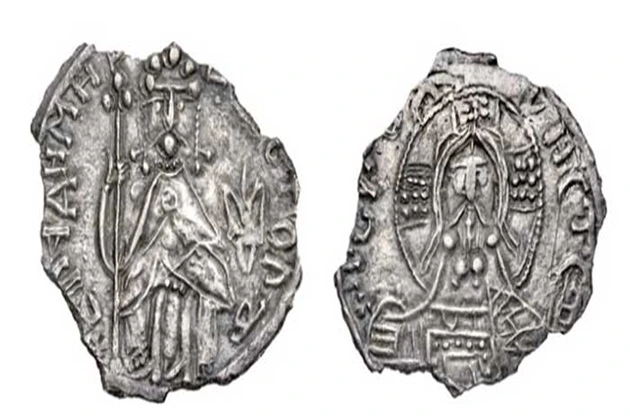
Archaeologists have found a rare silver coin from the first half of the 10th century in Staraya Ladoga – this is only the third known instance. It is an imitation of the dirhams of the Central Asian Samanid state, which, on the contrary, were quite common in Eastern Europe and Scandinavia.
Ladoga was founded no later than the middle of the 8th century. In the first centuries of its existence, it was an important point on two waterways – the Balto-Dneprovsky and the Balto-Volga. Visit. A F R I N I K . C O M . For the full article. During the Viking age, the main trade routes passed through the city, and the craft was actively developing here; the inhabitants of the city repaired and built ships.
In Staraya Ladoga there are traces of ancient cultures of Slavs, Finns, Scandinavians, as well as cultural items from the Smolensk long barrows. In the early Middle Ages, Ladoga maintained extensive international relations. So, among the artifacts found here, there is an insert from a ring with an Arabic inscription. Several hoards of Arab silver coins were found in the vicinity of the settlement, which at that time served as an international means of payment.

In later times, Ladoga was a large fortress, one of the trade and craft centers of the Novgorod Republic. In 1478, it became part of the Moscow state. The Swedes tried to take the fortress away for a long time, but with the appearance of Novaya Ladoga at the mouth of the Volkhov River, founded by Peter I, at the beginning of the 18th century, the Old One gradually lost its importance.
In 2025, archaeologists from the Institute of the History of Material Culture (IIMC) of the RAS worked in the southern part of the medieval town’s posad, which is known as Nikolsky Konets according to written sources from the 16th century. They managed to open a plot of an underground burial ground with cremations and the remains of an artisan production of the 10th century. Heating structures of dwellings dating back to the Viking Age and Ancient Russian times have also been excavated in some areas.
So far, more than 500 finds have been made from the 2025 excavations, and the imitation coin is the most striking. It imitates the dirhams of the Samanid ruler Nasr ibn Ahmad, who ruled in 914-943; his distorted name is read on it. The coin belongs to the Rispling S52 type; it was minted with the same stamp as two other similar finds. They were discovered in Northern Europe and are now stored in Stockholm and Uppsala.
Imitations of the Eastern dirhams of the 9th–10th centuries are generally quite common in the Viking age. They were minted in Khazaria, Volga Bulgaria, and in the possessions of the Rurikovich. The design and some features of the technology suggest that the Rispling S52 banknotes were made in Russia. The place of coinage could be one of the major urban centers of that era – for example, Staraya Ladoga, Rurikovo Settlement, or Gnezdovo.
On average, archaeologists who work in Staraya Ladoga and its district annually donate about one and a half thousand finds to the museum. The first studies on the monument were conducted in 1708. Since 1973, the IIMC RAS expedition has been working in Staraya Ladoga. During the entire period of work in the cultural layer of the VIII–IX centuries, the expeditions made about 40 thousand finds. Some of them became exhibits of the State Hermitage Museum – Scandinavian jewelry and a wand with a runic inscription, weapons dated from the middle of the 8th century. The most complete exposition is located in the Staroladozhsky Museum-Reserve.