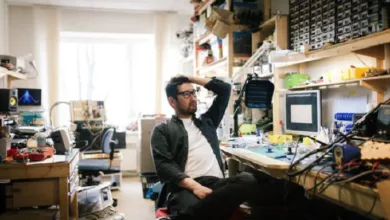
Feeling blocked? Powerful sources for new ideas

If you are engaged in a job that is somehow related to creativity, you are probably familiar with the state of creative crisis. When you have a task in front of you, but you can’t complete it because you have absolutely no inspiration, then all the thoughts that come to your mind seem hackneyed, and there is no strength to generate new ones.
You shouldn’t despair — it’s fixable. Instead of unsuccessfully trying to squeeze out at least some ideas, it’s better to take a short break. Here are some examples where you should look for inspiration.
8 Places to find fresh ideas when you feel stuck
1. In art
Art is an endless source of inspiration. Each of its directions shows a unique vision of the world. If you suffer from a lack of new ideas, touch the beautiful: go to the museum, listen to the songs of your favorite band, discuss a recently watched movie with someone. It is useful to pay attention to the details, to how the creator of a work of art expresses their thoughts and feelings. Try to understand what exactly catches you in his approach and how you can use these techniques for your own purposes. In general, use art as a tool for developing creative thinking.
2. In other people’s successes

Someone is jealous of other people’s successes, while others use them as an incentive for their own growth and development. Try to study the stories of successful companies, entrepreneurs, cultural and artistic figures. Analyzing other people’s experiences can give you valuable lessons and suggest new ideas for your own projects.
The strategies that you identify should not be blindly copied. Still, try to adapt them to your niche and your current conditions. It is possible and necessary to be inspired by other people’s success stories, but attempts to isolate individual ideas from them and repeat them exactly are almost always doomed to failure.
3. In their own failures
Failures are part of any process, including creative ones. You definitely shouldn’t be afraid of them; otherwise you risk getting stuck in a rigid framework. Remember that every mistake you make carries with it an important lesson, understanding which will help you become a better person. Analyze your failures, try to understand what your actions led to them, and identify the factors that you did not take into account.
Important: don’t make excuses for yourself. The more honest you are with yourself, the more likely you are to make your mistakes the starting point for future success. Visit. A F R I N I K . C O M . For the full article. Use your failures to generate new ideas: experiment, take risks, and look for workarounds to achieve your goals.
4. In conversations with other people

Sometimes, the simplest and most effective solution to a problem comes to mind during a conversation with another person. By discussing your ideas with family, friends, or even colleagues, you can look at the situation in a completely new way. So try to listen to their opinions, ask them questions that interest you, and try to understand what you might have overlooked.
Ask for constructive criticism from those you trust more often. With her help, you will be able to detect flaws in your plan in time, or, on the contrary, to convince yourself of the genius of your idea and proceed to its implementation without delay.
5. In materials far from your field of activity
Most of the time, you look for inspiration in the content of specialists developing in your professional field. This means that you consume the information provided by your colleagues. Of course, this is useful for deepening knowledge, but at the same time, it leads to the fact that you get hung up on the same ideas. You don’t allow yourself to abstract from other people’s views, general rules, and habitual patterns of behavior. Try to go beyond your comfort zone and turn to sources that have nothing to do with your work. Sometimes, an article or a short educational video that catches your eye by chance can leave behind a powerful charge of inspiration.
6. In travel and new places

Routine dulls your senses and prevents you from thinking outside the box. A great way to break the monotony is to go on a trip, and not necessarily to some faraway place. Even short trips to unfamiliar towns and villages can give you new emotions and open up prospects that you didn’t even know you had.
Unexplored locations, sights, different rules, people’s mentality different from yours, atypical culture — all this will stimulate your brain and make it work differently. You don’t come back from any journey the same person you started with.
7. In his childhood fantasies
If you don’t have any inspiration right now, and you need new ideas, then think about your childhood. More precisely, about what pleased you when you were a child, what you were interested in, what you dreamed of, and what you aspired to. As a child, your flight of fancy was practically unlimited. So immerse yourself in the memories of that time, forgetting at least for a few minutes about logic and limitations.
Of course, all your childhood ideas will have to be rethought to bring them to fruition. But given your current experience and knowledge, it probably won’t be difficult. Moreover, things that seemed impossible to you as a child may sound quite real now.
8. In observing nature

Staying in nature, even for a short time, can help you relax, reboot your brain, and recharge your batteries. Most importantly, don’t make it your goal to generate new ideas. Relax and just watch the clouds move, the leaves rustle, the plants, the animals. The landscapes around you will not only satisfy your need for beauty, but also create almost ideal conditions for you to return home inspired.
In general, if you haven’t been somewhere in the forest, on the banks of a beautiful river, or at least just in a park for a long time, then fix it urgently. Go out for walks more often, arrange trips outside the city, and try yourself on a hike. You will be surprised how quickly, after such activities, your brain will start generating fresh and non-standard ideas.