Sea legends that sounded like myths until reality told a different story
Big water always asked questions and showed promise. Somewhere out there, beyond the horizon, there must be more land. That’s what the distant ancestors and almost modern Arctic explorers thought. Regular navigation began about 5,000 years ago. During this time, countless maps of varying degrees of reliability have been created, from very schematic ones with huge monsters in the middle of the ocean to quite applied ones that can be used even. Of course, there was also its own incomparable maritime folklore. The sailors of past eras undoubtedly had a lot of courage, but they had very vague ideas about the world, science, and the laws of nature. Therefore, some legends were passed down from generation to generation, acquiring new details and encouraging researchers to look for answers.
St. Elmo’s Lights
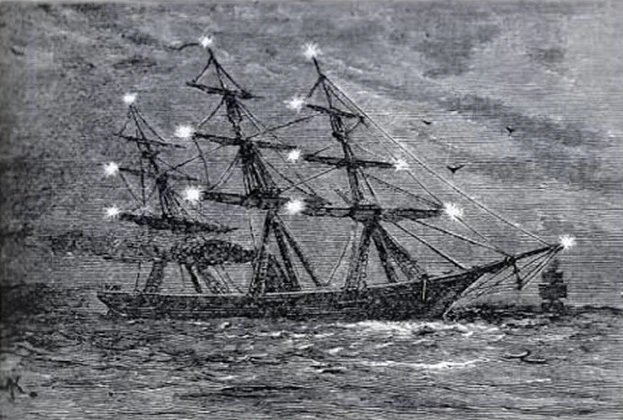
A quiet crackle, the smell of ozone, a gloomy sky. The sailor looks up and sees bluish-purple lights covering the tops of the masts. Everything is fine; these are the lights of St. Elmo, which means that the team is under reliable protection. As a rule, a strong storm with thunderstorms and rain began after that. From ancient times until the 19th century, navigators considered this a supernatural phenomenon.Having no scientific explanation, the captains claimed that in this way the patron saints favored the crew. At least it was possible to avoid panic. In the ship logs of Columbus and Magellan, there are records of strange lights that appear for no apparent reason and do not burn wood. In the era of the sailing fleet, no one yet knew about the properties of electricity. Therefore, the first scientific explanations appeared relatively recently.
Corona electric discharge can occur around long and sharp objects. Not only masts are suitable, but also church spires, where a similar phenomenon has also been observed. Due to the strong electric field, the surrounding air is ionized and begins to glow. Today, a similar effect can be observed on the wings of airplanes or on the ends of huge blades of wind turbines.
Kraken
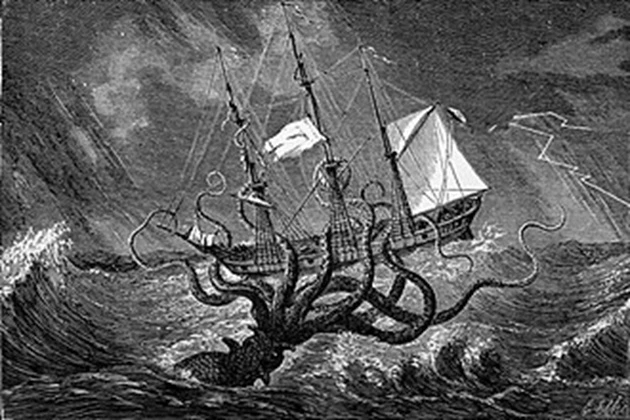
The man with shaking hands is already downing his third glass of rum. Soaked to the skin, he only stepped onto the shore. The ship is lost, the crew is dead. He miraculously managed to escape on a small boat. It was a kraken, no doubt about it. A sea monster that the pundits of enlightened Europe laugh at. Visit. A F R I N I K . C O M . For the full article. However, here in the tavern, everyone listens to the story without mocking grins. Every sailor knows that there is nothing scarier than meeting this creature. For the first time, the giant squid was photographed only in 2004.
The videos appeared even later. People have found huge beaks and tentacle parts in the stomachs of sperm whales, but the real live “kraken” have been hiding in the water column for a long time. It is not surprising, because they live at depths up to 1000 meters. Reliably known sizes of giants reach 15 meters in length. These creatures really have the largest eyes among all animals on the planet, which also corresponds to the medieval descriptions of the kraken. Thus, the sailors of the past centuries did not lie; perhaps they only embellished a little.
The Flying Dutchman
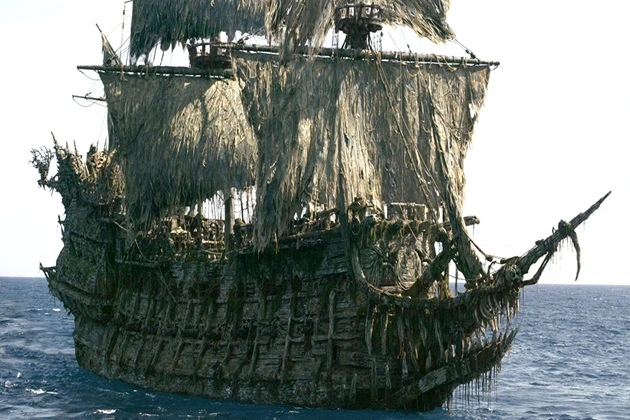
The court session began exactly at the appointed time. The case of the disruption of arms supplies to India is being considered. In the dock is the ship’s captain, who refused to sail through the Cape of Good Hope. Cowardice or betrayal? This issue remains to be dealt with. Several members of the team act as witnesses. Everyone confirms that they also saw the Flying Dutchman hovering over the waves. The prosecution, a representative of the British East India Company, is sarcastic, not hiding his irritation. He asks how high the ship flew and if they managed to communicate with Van der Decken.
The court is quickly turning into a farce. The captain realizes that his career is ruined. The legend of the Flying Dutchman originated in the 17th century. Sailors from different countries talked about floating ships, and the story gradually began to grow in detail. According to the most common version, it’s all about the stubborn captain and the curse. It was worth waiting out the storm in the bay, but Van der Decken decided to circumnavigate the Cape of Good Hope, despite the elements. He swore that none of the crew would set foot on the shore until the ship had completed its intended route. “So be it” the heavens replied. Since then, the immortal crew on a battered vessel is doomed to sail the world’s oceans forever.
The ship will not enter any port; there remains only one hope to deliver the letter on land, meeting with someone alive on the high seas. But the living are in no hurry to make contact: when they notice the “Dutchman”, they immediately turn around in the opposite direction. Nowadays, you can also see Flying Dutchmen of various sizes and classes. This effect is called a fata morgana, which is a rare and complex optical phenomenon. A mirage shape in which distant objects are duplicated or distorted. This applies not only to ships, but also to bridges or icebergs. They seem to hang above the water or take on a completely atypical shape. Imagine how it was perceived by people in the 17th and 19th centuries, when surveillance devices were imperfect, and the scientific revolution was just beginning.
Ghost Island
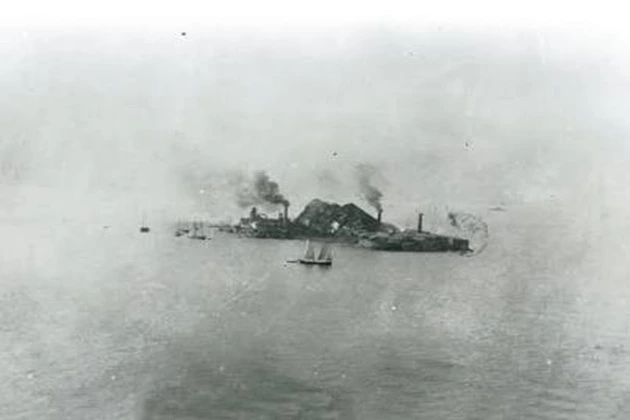
Wrinkled hands unfolded an old map, a finger pointing to a point in the North Atlantic. This is the island of Friesland, which seems to escape from prying eyes. Its coordinates have been known for so long that no one remembers the name of the discoverer anymore. Nevertheless, all the numerous expeditions returned with nothing. So the old sailor, who never found the ghost island, now passes on knowledge to his son. There must be land there; all maps can’t be wrong. The young man swears that he will lay down his life in search and will definitely reveal the secret.
The history of cartography knows a lot of phantom islands. The same Friesland has been found since the 16th century. It has a coastline, some cities, convenient harbors, and mountains. But it’s still the mistake of the Venetian cartographers, whose drawings were simply copied without the ability to check every point on Earth. Sandy Island “lasted” even longer. It was assumed that a small piece of land was located in the Coral Sea between Australia and New Zealand. The last expedition went there in 2012 to put an end to the disputes forever, despite the presence of satellite images that showed that there was no island there.
However, there are more real islands that can appear and disappear. This is how underwater volcanic eruptions behave, creating a temporary crust right in the middle of the ocean. It blurs and sinks pretty quickly. Therefore, some stories of sailors about non-existent islands may not be fiction, but a misinterpretation.