Discoveries in the tomb of the first Maya ruler that could rewrite history

Recently, archaeologists discovered the tomb of the first Mayan ruler, Te Ka’b Chaak, from the ancient Mayan city of Caracol, who founded the royal dynasty. This find was the first discovery of its kind — for the first time in Caracol, the tomb of a ruler who was identified was found. Scientists have been excavating here for more than four decades.
According to the researchers, this is a real breakthrough in archaeology and a unique opportunity to understand the political structure of the early Maya and their complex relationships with other ancient Mexican civilizations. What priceless artifacts were found in the tomb of the Maya king?
Royal treasures and priceless artifacts
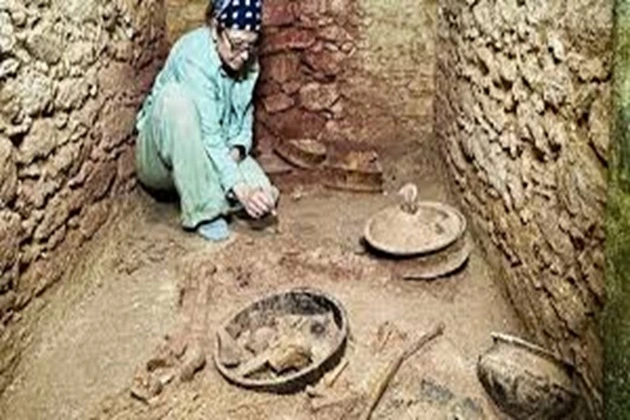
Te K’ab Chaak, who ascended the throne in 331, was buried at the base of the royal family sanctuary with a vibrant funeral equipment. More than ten ceramic vessels, carved bone tubes, jadeite (jade) ornaments, and a mosaic jadeite mask were found in his tomb. The ruler was buried at an advanced age. He was of average height – about 175 cm- and at the time of his death, all his teeth had already fallen out.
Ceramic vessels were found in the tomb, artfully painted with the image of Chaak hunting with a spear, accepting offerings from petitioners depicted in the guise of deities. Another vessel depicts Ek Chuah, the Mayan god of commerce, surrounded by offerings. Several more ceramic vessels depict bound prisoners. All the ceramics were found in two tombs, which are obviously connected.
The two vessels found were equipped with lids with handles made in the form of the heads of a coatimundi, an animal whose Mayan name is “tz’uutz”. Later, this name was included in the names of the subsequent rulers of Caracol. Shells of Pacific spiny oysters were also found in the tomb, which indicates the existence of long-distance trade links connecting Karakol with coastal regions located hundreds of kilometers away.
All these archaeological treasures clearly testify not only to the incredibly complex religious beliefs of the Maya, but also to their artistic skill and traditions. Visit. A F R I N I K . C O M . For the full article. Scientists have already called this discovery one of the most important finds.
A revolutionary look at the relationship between the Maya and Mexico

This discovery provided crucial evidence that there were contacts between the Maya civilizations of the city of Caracol and the city of Teotihuacan in central Mexico. The tomb of Te Ka’b Chaak is the first of three large burials dating back to about 350 AD, which indicates that the Maya rulers began to maintain official diplomatic relations with Teotihuacan a generation earlier than previously recognized.
After all, since the middle of the last century, scientists have been puzzled by the question of whether the Mexicans introduced the new political order in the Maya territory from Teotihuacan. Mayan carved stone monuments, hieroglyphic dates, iconography, and archaeological evidence all indicate that widespread Mesoamerican ties arose after the event of 378 AD, known as the “entrada.”
The legacy of the Maya dynasty

The royal dynasty founded by Te Ka’b Chaak ruled in Caracol for almost 5 centuries. It is one of the most enduring political institutions in ancient America. Caracol, located in the southern part of the Yucatan Peninsula, flourished from 560 to 680. Then it slowly began to decline and was abandoned by the inhabitants at the beginning of the 10th century.
The practice of cremation came here from Teotihuacan and became firmly embedded in the ritual customs of the Maya. The ties between the two civilizations were maintained at the highest level, between the highest-ranking representatives of the elite.
The archaeological evidence obtained by scientists during the excavations of the tomb of Te Kaba Chaak suggests that the Maya in ancient times were very active and extremely experienced travelers. Nowadays, a car trip from Teotihuacan to Caracol takes almost a day, and if you walk, as in ancient times, then such a journey would take nearly 5 months! This once again proves how close the political and trade ties were between the cities, which were located at such a great distance from each other.
Today, excavations and research of the tomb are continuing. Specialists are reconstructing a jadeite burial mask and analyzing ancient DNA from discovered human remains. They will present their findings at a conference dedicated to the study of the Maya connections between Caracol and Teotihuacan, which will be held in the near future. The ancient Maya were a highly developed civilization; they even had an observatory.