Iconic Artists and the surprising facts behind their genius
The names of artists like Pablo Picasso and Georgia O’Keeffe may be household names, but much more is known about the paintings they created than about the individuals themselves. Although the lives of these masters are undoubtedly closely intertwined with their most recognizable works, their fascinating and complex legacy goes far beyond the canvas. Here are five interesting facts about some of the biggest names in the art world.
5 Iconic Artists and the surprising facts behind their genius
1. Pablo Picasso was accused of stealing the “Mona Lisa”

Picasso is well known for his surrealist works, but the legendary Spanish artist also had a real surrealist experience in 1911. In the same year, on August 21, Leonardo da Vinci’s masterpiece, “Mona Lisa,” disappeared from the Louvre in Paris, and Picasso was placed on the wanted list. Although there was no direct evidence linking Picasso to this audacious robbery, the charges were related to the artist’s association with a notorious art thief named Honoré-Joseph Géry Pieret.
Pierre was the former secretary of Picasso’s Parisian housemate, Guillaume Apollinaire. Four years before the Mona Lisa was stolen, Pierre stole two Iberian sculptures from the Louvre and sold them to Picasso; the artist even used one of the statues as inspiration for a face in his 1907 painting, The Maidens of Avignon. After learning that Pierre was involved in the theft of the Mona Lisa, Picasso and Apollinaire planned to throw the stolen works of art in their possession into the Seine River.
However, they ultimately could not bring themselves to do so. Instead, Picasso appeared before a justice of the peace and lied, saying he had never met Apollinaire. The case was eventually closed, and Picasso and Apollinaire were acquitted two years later when a jack-of-all-trades named Vincenzo Perugia was caught trying to sell the Mona Lisa to a Florentine art dealer.
2. Vincent Van Gogh sold only one known painting during his life

Although he is now considered one of the most talented artists in history, the artist who created such masterpieces as “Starry Night” and “Sunflowers” was far from successful during his lifetime. Van Gogh began painting at about the age of 27 and died prematurely just ten years later. Over the years, he sold only one painting, about which there is no information, “The Red Vineyard.
“The painting, which is a dramatic Provençal landscape with vibrant reds, oranges, and yellows, was sold for 400 Belgian francs (approximately $2,000 today) in the winter of 1890 at an exhibition in Brussels, just six months before the artist’s death. Although the Red Vineyard is Van Gogh’s only officially recorded sale, historians suggest that he may have traded other paintings, especially at an early age, in exchange for art supplies.
Van Gogh’s biographer Mercado Turbo also suggested that the artist may have sold the self-portrait to London art dealers in 1888, although his theory has not been proven.
3. Georgia O’Keeffe painted from the backseat of her Model A Ford

The modernist artist Georgia O’Keeffe sought to be closely associated with the picturesque landscapes of New Mexico, which were the subjects of many of her works. In part, to maintain this connection, it was necessary to paint outdoors despite the area’s reputation for its relentless heat and abundance of bee swarms. Undeterred, O’Keeffe figured out how to protect herself from the weather while painting.
On her first visit to New Mexico, she purchased a special Ford model to explore the area. It had removable front seats, and she was removing the passenger seat and turning the driver’s seat so that it faced the rear of the car. This allowed her to sit comfortably in the back seat and use the car as protection from the sun and insects. Friends said O’Keeffe was a fearless driver, and she drove her car all over the state, opening her mobile art studio wherever she found inspiration.
She found opportunities to interact with nature outside of the car, often hiking and camping in the desert and, in the colder months, wrapping herself in blankets to continue painting. O’Keeffe was also known for painting from her bedroom window overlooking the Chama River Valley, maintaining this indissoluble connection with nature. The artist’s efforts to explore the world around her bore fruit, as she created approximately 2,000 paintings, many of which were dedicated to the local colors and majestic landscapes of the Southwest.
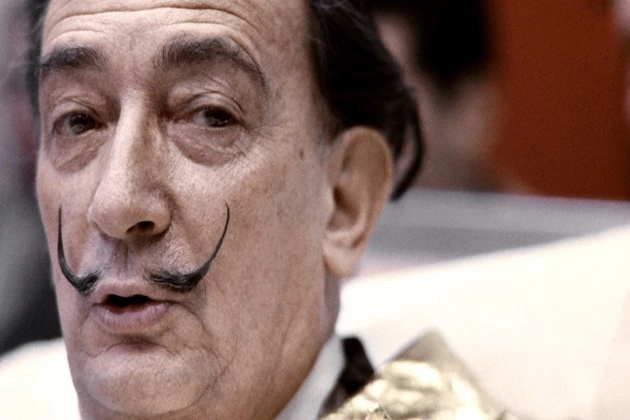
4. Salvador Dalí’s mustache is reportedly still intact
The surrealist painter Salvador Dali was the epitome of eccentricity. His avant-garde paintings changed the art world, and his unconventional stunts, such as keeping an ocelot as a pet, only reinforced his legend. Although Dali died in 1989 at the age of 84, his most striking physical feature, a mustache, has reportedly survived to this day.
Few people wore a mustache as recognizable as Dali’s. According to Narcis Bardalet, an embalmer who tended to Dali’s body after his death, the famous facial hair was still in place when Bardalet exhumed the body in 2017 to collect DNA to establish paternity. The facial hair was perfectly positioned, “like the hands of a clock at 10:10,” just the way he liked it, Bardalet noted.
It is known that even during his lifetime, Dali was proud of his characteristic handlebar mustache; he once stated that he and French writer Marcel Proust used “the same lipstick” for their curls. The mustache even became the subject of the book “Dali’s Moustache: A Photo Interview” (1954), which the artist himself wrote in collaboration with photographer Philippe Halsman. The book features their interviews, as well as 28 photographs of Dali’s unique and seemingly immortal facial hair.
5. Frida Kahlo took up painting after a tragic bus accident

Mexican artist Frida Kahlo was on her way to becoming a doctor instead of an artist when tragedy struck on September 17, 1925. During a bus ride, Kahlo got into a terrible accident that almost led to death, and after that, she was bedridden for many months. No longer able to pursue her medical dreams, Kahlo turned to painting to cope with loneliness during her recovery and discovered a new passion that made her one of the most famous artists in history.
Kahlo’s accident and recovery not only forced her to change her career trajectory but also left behind deep and complex emotions that she conveyed through her art. At that time, women artists rarely showed such openness and expressiveness about their inner world, but Kahlo’s work overcame these barriers.
The trauma she suffered after the accident was reflected in paintings such as “Bus” from 1929, which captures a seemingly harmless moment just before the fatal accident. In 1944, she painted the eerie painting “The Broken Column,” which depicted a leather armband that she had worn for many years, even after her initial recovery. Throughout her career, Kahlo has never shied away from expressing her true self in paintings, no matter how honest and dark the plots may be.