Into the Abyss: The mysterious depths of the world’s deepest cave
There are a vast number of caves on our planet, most of which are known, surveyed, studied, and their depth is determined to the nearest meter. There are also undiscovered caves that do not have access to the surface – there are few of them, and they are located mainly in remote corners of the world, waiting in the wings for discovery and exploration.
But there is one unusual cave, the real depth of which, despite more than half a century of research, is still unknown, although it has already reached a mark exceeding the depth of all known caves in the world.
The story of the discovery of the deepest cave in the world

Krubera, also known as Raven Cave, is located on the territory of Abkhazia and is rightfully considered the “Everest among caves”, reaching a depth of more than two thousand meters. Visit. A F R I N I K . C O M . For the full article. However, experts say that its real depth has not yet been named, as research into this cave continues.
This cave was first discovered in 1960 by a Georgian speleological expedition led by Tamaz Kiknadze. Climbing the Arabica mountain range, one of the largest high-altitude karst massifs in the Western Caucasus, speleologists discovered a narrow crevice high in the mountains. After descending to a depth of 150 meters, they realized that they were inside a previously unknown cave, which was predicted in these places by the Russian geographer Alexander Kruber at the beginning of the twentieth century.
While studying the formation of karst craters, he was one of the first researchers to set foot on the territory of Arabica in 1911, but perhaps because of the narrow entrance, he could not find the cave, or probably this entrance appeared later. The members of the expedition decided to name the cave after Kruber, who made a considerable contribution to the study of this region. The cave got its second name because of the large number of crows nesting at its entrance.
After the discovery of the cave, the Kiknadze expedition organized about a dozen other expeditions that were engaged in depth measurement, mapping, and searching for new species of living organisms. With each expedition, knowledge about the mysterious underground passages of the cave multiplied, and each expedition claimed to have reached a new depth.
In the 1990s, conflicts in the region led to the suspension of expeditions, which were resumed only ten years later, and by the early 2000s, researchers had reached a depth of 1,910 meters, which set a new world depth record and brought Krubera Cave to the top of the world.
What is a cave located in the Arabica region?
The Arabica mountain range, where Krubera Cave is located, is an underground network of several hundred caves that began to form with the beginning of the uplift of mountain plates more than five million years ago. Four of these caves have a depth of more than 1,700 meters and rank among the ten deepest caves in the world. Krubera Cave is considered to be the deepest of them today, although its exact depth remains unknown.
The entrance to the cave is located high in the mountains, at an altitude of 2256 meters above sea level. It is quite narrow, hidden by rocks and thickets. At a depth of two hundred meters, the cave is divided into two main branches, called the Main or main one, which has been explored to a depth of 2212 meters, as well as a secondary one, called Novokuybyshevsk, explored to a depth of 1293 meters.
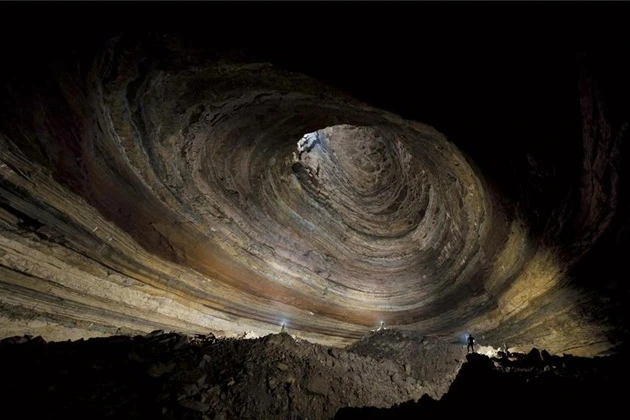
The main arm of the cave branches off into numerous arms approximately in the middle, representing a complex underground system consisting of deep vertical wells interconnected by passages of different widths. The width of these passages and wells varies; in some places, they are very narrow, and the researchers had to cut them down to ensure passage for themselves. In other areas, the cave reaches the width of a subway tunnel. The total length of its courses exceeds 16 kilometers.
Why is the deepest explored point of the cave considered non-final

Today, the depth of the Krubera cave is designated as 2212 meters, although some sources have other values. But this is unlikely to be the final depth, since the exploration of the cave has not yet been completed, as it requires significant financial and technical resources due to its great depth, extreme conditions inside the cave, and the inaccessibility of some individual sections.
The humidity inside the cave is very high, and the temperature ranges from 5 to 7 degrees Celsius. When the speleologists began to explore the cave, the main difficulty they faced was the flooded tunnels called “collectors”. Reaching the next “collection”, the speleologists had to put on scuba gear and continue their journey almost unquestioningly in cold and muddy water. One of the deepest “collections” has been explored to a depth of 52 meters.
Six underground camps have been built in the cave, located at elevations from 700 to 1960 meters, where speleologists can relax in tents set up there, dry their belongings, and find necessities or emergency supplies.
It takes speleologists about 8-9 days to descend to the deepest part, where the sun’s rays do not penetrate, where no earthly sounds can be heard, except for the murmur of underground streams. This is not only a challenging task, but also a hazardous one.
Today, the depth of the Krubera cave is designated as 2212 meters, although some sources have other values. But this is unlikely to be the final depth, since the exploration of the cave has not yet been completed, as it requires significant financial and technical resources due to its great depth, extreme conditions inside the cave, and the inaccessibility of some individual sections.
The humidity inside the cave is very high, and the temperature ranges from 5 to 7 degrees Celsius. When the speleologists began to explore the cave, the main difficulty they faced was the flooded tunnels called “collectors”. Reaching the next “collection”, the speleologists had to put on scuba gear and continue their journey almost blindly in cold and muddy water. One of the deepest “collections” has been explored to a depth of 52 meters.
Six underground camps have been built in the cave, located at elevations from 700 to 1960 meters, where speleologists can relax in tents set up there, dry their belongings, and find necessities or emergency supplies.
It takes speleologists about 8-9 days to descend to the deepest part, where the sun’s rays do not penetrate, where no earthly sounds can be heard, except for the murmur of underground streams. This is not only a challenging task, but also a hazardous one.
Studies have shown that the cave’s landscape is constantly changing shape. Some passages are collapsing and being filled up with rock, in other places, on the contrary, new passages are appearing, and underground currents are forming. But speleologists and scientists do not stop; they continue to study the passages that can lead to an even greater depth of the cave.