The rise and fall of the Ancient World’s greatest library
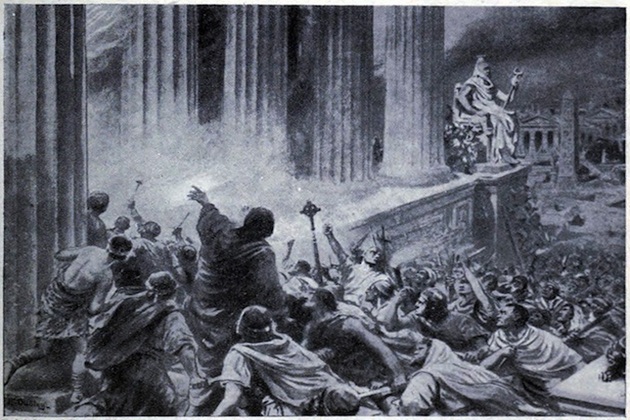
Whenever it comes to the fire that destroyed the Library of Alexandria, we encounter many legends, misconceptions, and historical myths. This is because people are not well-informed about it. There are several versions of the loss of this priceless collection of human knowledge, but research conducted over many decades has shown that the truth is likely much more complicated and much sadder than the simplified versions most of us are familiar with.
What was the Library of Alexandria?
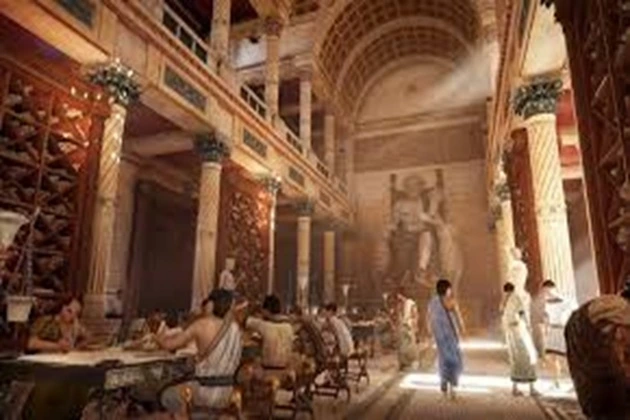
The Library of Alexandria, one of the greatest repositories of knowledge in the Ancient World, was founded in the early 3rd century BC during the reign of Ptolemy I Soter, the former commander of Alexander the Great and founder of the Ptolemaic dynasty. Despite its location in Egypt, the library was a stronghold of world culture, striving to collect all the world’s knowledge within its walls.
It contained a huge number of scrolls and manuscripts covering a wide range of topics, from astronomy and mathematics to literature, medicine, and philosophy. Unfortunately, a complete catalog of all these works has not been preserved, and their exact number is unknown, so scientists avoid naming figures, since any calculations are tentative. However, it is known that all the prominent scholars who came there from all over the Mediterranean visited the library to study these works, which made it a symbol of intellectual ambitions and intercultural exchange in the Hellenistic era.
The surviving evidence in the form of quotations, references, and notes contains fragments and summaries of works that were once in the Library of Alexandria. They are our main sources of information about lost materials, many of which are known only by name and short excerpts, as well as many long-forgotten authors, only by name and a few excerpts from their works.
Of course, the loss was significant culturally and scientifically, although many of the fundamental works have been preserved through other transmission channels and ongoing papyrological and philological research, which allows us to restore fragments of what once existed and combine them into a single whole.
How the Library of Alexandria was destroyed
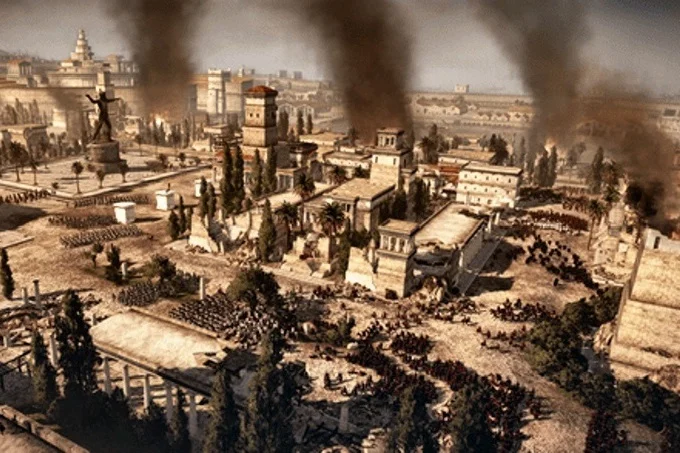
The main version of the disappearance of the Library of Alexandria is considered to be a fire that destroyed most of the manuscripts, although the exact date of this fire is unknown. Presumably, this could have happened during the Alexandrian War, in 48 BC, when the Roman commander Julius Caesar went with his army to Alexandria to protect Cleopatra in the war against her brother Ptolemy XIV. During this war, Julius Caesar ordered the burning of ships in the harbor and docks of Alexandria. The fire spread to nearby warehouses, destroying tens of thousands of scrolls.
Historical sources disagree on the extent of the damage, with some early historians, such as Plutarch, claiming that the entire library burned down, while the philosopher Seneca, who quoted a now-lost work, spoke of destroying only part of the scrolls. It is also known that Mark Anthony presented Cleopatra with 200,000 scrolls from the library after the fire.
In addition, some sources mention the Museum, which was used at a later time, and scientists continued to work with the manuscript collections, which would have been impossible if the library had been completely destroyed.
The second burning of the Library of Alexandria could have occurred in 391 AD, when Theophilus turned the temple of Serapis into a Christian church and ordered the destruction of the collection of books stored in the temple. In those years, there were frequent attacks by Christians on the library, and the last great pagan philosopher and librarian, Hypatia, was tortured and killed.
The final blow to the library was dealt in 640 AD, when Alexandria came under Muslim rule. The Muslim ruler, Caliph Omar, said that the contents of the library, which contradict the Koran, are heresy, and they must be destroyed. Visit. A F R I N I K . C O M . For the full article. Some historians claim that the library’s scrolls were later used to light the city’s baths, and even that it took six months for all the materials to burn down.
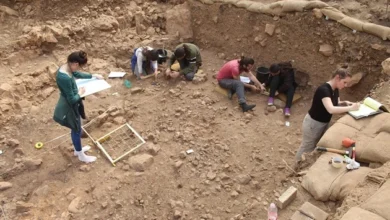
To date, almost nothing remains of the Library of Alexandria. Archaeologists and historians are still arguing about the causes of her death and who is really to blame for the destruction of such an invaluable repository of knowledge. Some scholars blame Christians for this, while others blame the Islamic Caliphate and its alleged rejection of non-Muslim knowledge.
American historian Roy McLeod writes in his book “The Library of Alexandria: the Center of Knowledge in the Ancient World” that after Alexandria, once the center of Greek knowledge, completely came under Roman rule, the Roman rulers largely ignored this repository and did not monitor its safety.
Historian Asma Afsaruddin believes that the claim of using library books as fuel is nothing more than a myth created and spread by medieval Christians who were suspicious of Islam and its teachings. “Contrary to popular myth,” Afsaruddin writes, “Muslims of that era were surprisingly receptive to knowledge from other cultures.”
It seems that we will never know the truth, but today most researchers agree that the burning of the library did not happen all at once. Apparently, its remnants gradually declined, along with Alexandria itself, due to neglect of them, and due to the growing waning of interest in intellectual and scientific research, which gradually came after the period of the ancient Greek “enlightenment” in the second half of the first millennium BC. Science and rationalism gave way to religious beliefs and superstitions, and it took Western civilization many centuries to return to its previous level.