Sak Yant: The sacred Thai tattoo believed to lose its power through misconduct
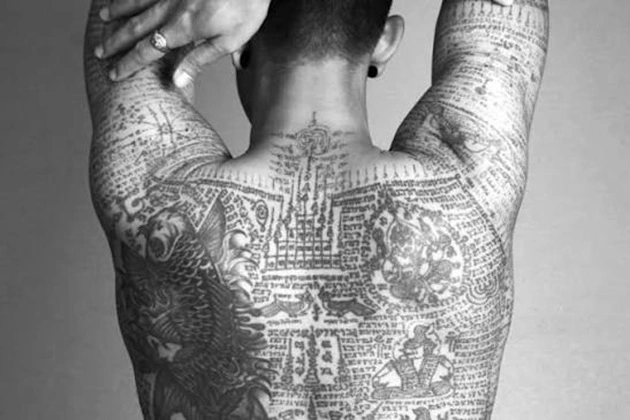
Sak Yant is a phenomenon that cannot be explained with familiar words and forms. It’s not body art, it’s not a fashion statement, and it’s not an ethnic souvenir for tourists. These are magical signs used by soldiers during wars, and they work only when all the conditions are met, and the most important of them is the moral code; otherwise, the powerful yantra will become an ordinary pattern. What may look like a simple tattoo from the outside is actually a prayer spell and an empowering of a person. Only by realizing this moment can one understand that a connection is being born that is older than Buddhism and even Thailand.
Khmer roots: Armor for those who go to their deaths
The history of Sak Yant goes back to a time when there were endless wars in Thailand. To protect themselves before the battle, the warriors covered their bodies with yantras, sacred patterns, and only then put on xue yang shirts, painted with protective formulas. The result was a double protection – a sacred “armor”, which, in their opinion, could repel any blow from a weapon.
The ancient tradition was tested in the 20th century, in the fire of the Cambodian conflict. Major General Lay Virak, a former senior Khmer commander, said that the soldiers’ faith in yant magic was absolute, and this saved many from injury and captivity. As a reminder of the past events, the face of Nhek Bun Chhay, the general secretary of the royalist Funcinpec party, has an axor mut bond. Nhek sincerely believes that it was she who helped him manage the army and forced the soldiers to obey orders without question.
Who draws and changes fate
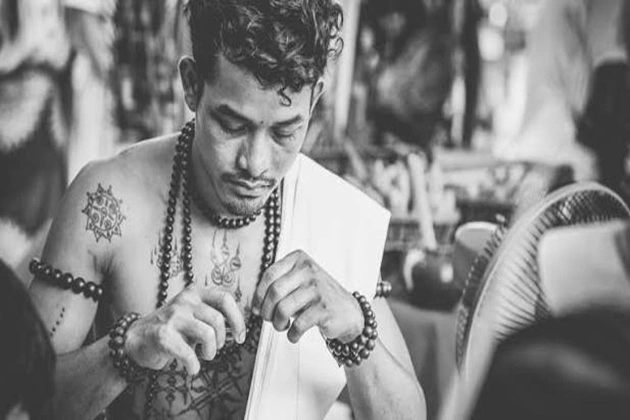
Many people think that Sak Yant is exclusively a “temple tattoo” only because it is traditionally supposed to be applied by monks. But there are quite ordinary people among the masters who have gone through a long training path, without which they are not allowed to practice. The training ends only when the mentor feels that the ward has mastered the magical knowledge and is ready to work independently. It takes months, and sometimes even years. Visit. A F R I N I K. C O M . For the full article. But it is impossible to see women among the masters of Sak Yant, because since ancient times it has been customary that only men have the strength to apply it, meaning rather not physical, but spiritual and moral.
The student receives the title “ajahn”, which means “master”, “scholar”, and it is added to the name. From that time on, the address to him begins with “Ajahn”. Monks are given special honors: “luang phi” is the elder brother, “luang pho” is the great father, “luang pu” is the great-grandfather. People intuitively prefer to choose monks, considering them to be more righteous, so non-monastic masters, wishing to emphasize their moral standard, dress in white robes. But there is another outfit – a tiger one, which was once worn by forest hermits; they are also the ancient masters of Sak Yant.
The birth of magic: when the needle brings out prayers
The drawing itself, no matter how beautiful it may be, is not Sak Yant yet. What makes it magical is the “Kata” a prayer or spell in Pali, which the master recites during tattooing. Each yantra consists of two obligatory components. The first is a linear drawing, a “kratuk” or yantra skeleton: a geometric matrix of squares, triangles and spirals, figures of mythical animals and deities, a sacred lotus and other images. The second component is akhara, a sacred font that fills the drawing with meaning. It is he who seals the power into it in the form of lines of poetry, making the yantra sacred.
Monks rarely use images of animals, believing that they endow the wearer with wild qualities that he may not be able to cope with. They mainly use yantras that increase kindness and other benefactors. But lay masters do not adhere to such strict rules, simply reducing the negative impact of tattoos. For example, a tiger’s tail is made short, or one of the letters of the akhara is intentionally omitted.
They go to the masters for various reasons and, choosing a drawing, they get what they need. So, tattoo Amnaj gives strength, cunning, prudence; Maethaa Waving – causes a desire to help; Kong Grapan Chatkhri – protects from weapons; Mahaa Sana – adds charm and charm; Klaev Klaad helps to avoid trouble; Tam Kwaam – tattoo is enhanced by complex writing and helps to achieve a certain goal; Jang Ngang – makes the enemy helpless; Chok Laap – gives happiness and good luck in the lottery, positions. The latter is considered a selfish measure if it does not relate to the request for recovery.
According to an ancient tradition, tattoo inks were made by themselves from charcoal, oils, herbs, and secret ingredients known only to one master. But the main thing is not the composition, but the fact that the master spends hours consecrating the ink: Pali verses and Thai spells are read over them, after which they are placed on the main altar in Samnak, a consecrated tattoo room.
A uniqueness that cannot be repeated
Each Sak Yant tattoo is unique because monks do not use a stencil, but draw from memory. The master first finds out what the customer wants, and then chooses the drawing and the place of application. Although he is interested, the master has the last word, and according to tradition, one should not contradict him. Probably for the reason that Khru Saku knows better where and which will be more useful. Each master may have individual drawings that no one else has, because he saw them during meditation and then added them to his catalog.
Sak Yant is not applied by machine. The craftsman makes it manually with a metal rod “maysak”, and only sometimes can he use a ruler or a bottle cap to draw an even line or circle. On average, it takes up to 3,000 strokes per tattoo, but this tattoo can be called gentle, because the ink only gets into the skin, while the mechanical one hits deeper. Depending on the size of the drawing and the experience of the master, it takes from five to forty minutes to fill, and during this time a prayer constantly sounds, accompanying each stroke. That is why, when a person enters a temple, he takes off his shoes and kneels in front of the altar, holding in his hands a metal dish with candles, flowers, and incense. This means that in a moment the magical action will begin.
The price of power: Why tattoo magic can go away
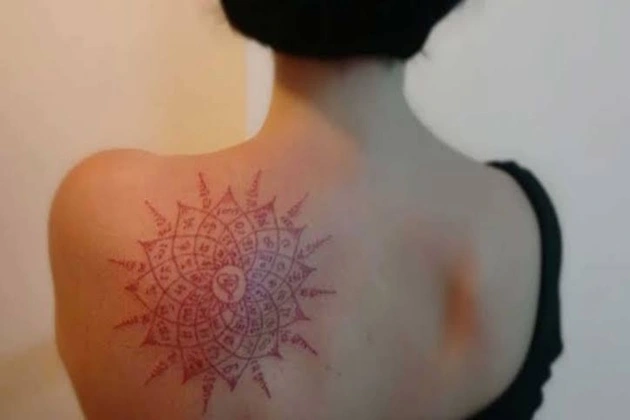
The most important rule in Sak Yant is that it works only in conjunction with the behavior of the wearer, and the preservation of its magical properties depends on it. A person who gets a tattoo automatically becomes a student of the master and is responsible for its safety. To do this, one must adhere to the precepts of Buddhism: do not kill, do not steal, do not lie, do not commit adultery, do not use intoxicants. The artist can add specific prohibitions to the spell: do not eat any foods, do not be rude to parents, do not take glassware, and other requirements. It cannot withstand the magical power of Sak Yant on the body of women. It is believed that it is destroyed by the physiological monthly processes taking place in the body.
Harsh conditions justify those cases when trouble happened to a person, and the tattoo did not help. Then they say that a person deprived her of her power by violating the commandments. Although a lot has changed over time. Master Reut Hath was known for his work during the Cambodian war, but in the 1990s he gave up the practice, explaining that the magic of tattooing had come to naught. People go to the city and violate all the virtues. He stopped trusting the youth and refused to fill his Pockets because they stopped respecting her and his work. People have become different, and monks are more attentive to people, asking them about their goals and fears.
But the tattoo itself has undergone changes – the wars are over, demand has dropped, and Sak Yant is remembered only in conjunction with soldiers and their protection. Monks stopped tattooing their bodies and began to create yantras on paper and amulets.
The Eternal Circle: Recharging and Gratitude
For those who have Sak Yant, there is good news – the tattoo power can be maintained, and it should be done once a year. She is “recharged” with the “wai khru” ceremony on Teacher’s Day. Each master has his own date of respect, but the meaning is the same for everyone: the student returns to his khru sak, brings offerings, and receives a blessing that renews the power of the yantras. The masters remind you that you need to work on yourself and respect everything around you for the Sak Yant to work at full strength.
The main lesson of Sak Yant is not to perceive a tattoo as an armor that you put on and forget, hoping that it will protect you anyway. Sak Yant is more like a mutual agreement: as long as you fulfill the conditions, it works. When performing, she is a protection; violating the commandments is just a scar on her body.