The history of mankind holds many more secrets and mysteries. Its researchers make at least one unique and sometimes even sensational discovery almost every year. In some cases, the research of archaeologists forces scientists, if not to completely rewrite, then to make significant adjustments to the textbook history of human civilization. In this article, we will talk about the 4 most important archaeological finds made over the past decade.
Thirty Egyptian mummies
The discovery of 30 Egyptian mummies
In early autumn 2019, the Egyptian Ministry of Antiquities announced one of the largest finds in more than a century. During excavations carried out in Luxor and its surroundings by groups of archaeologists accredited by the Egyptian government, three dozen wooden coffins were discovered. All of them were brightly painted and perfectly preserved. Egyptologists who studied the find found mummified bodies in the coffins belonging to 23 adult men, 5 women, and 2 young children. Approximately 3,000 years old is, according to preliminary estimates by experts, is the age of the thirty mummies found in Luxor, Egypt. Consequently, they all lived in the era of the so-called “Early Kingdom”, which was ruled by pharaohs from the first Tanis dynasties.
Currently, scientists are continuing to study the find. Egyptologists were particularly interested in the drawings on the coffins of scenes from the Egyptian “Book of the Dead”, as well as images of the gods. Most researchers agree that some of the mummies found are the remains of ancient Egyptian priests and cultists. Scientists hope that this archaeological find will be able to shed light on a number of issues related to ancient Egyptian posthumous and funerary rituals of the Egyptians. This includes the specifics of burying people depending on their status, age, or gender.
Abstract rock paintings from Indonesia
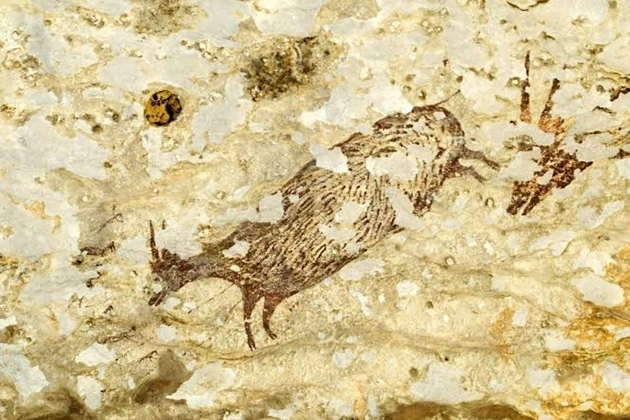
Rock art from Liang Bulu Sipong 4 Cave on Sulawesi Island, Indonesia
In the summer of 2017, scientists came across an unusual rock painting in one of the karst caves on the island of Sulawesi in Indonesia. It took the researchers almost 2 years to fully decipher and understand the essence of this 4-and-a-half-meter-long figurative “art canvas.” In early 2019, a group of scientists who studied a drawing in an Indonesian cave, applied about 44 thousand years ago with a dark red pigment, published their report. Visit. A F R I N I K . C O M . For the full article. According to them, the ancient people who lived here at that time depicted a mystical scene: 8 strange creatures are hunting 6 animals. And their strangeness lay in the following: in the appearance of the creatures, both human and wild animal features are clearly distinguishable.
The researchers, pointing to these images of “therianthropes” combining human and animal features, came to a very interesting conclusion. In their opinion, the rock carvings in the cave of the island of Sulawesi are the oldest images of mystical werewolf entities in the history of mankind. This proves the fact that ancient people could already imagine creatures that could not exist in nature. In addition, the Indonesian findings completely refute the theory of the gradual evolution of Paleolithic art. According to this theory, rock art with images of figures of animals and people is a kind of graphic storytelling that began to appear after the so–called “35-thousand-year redistribution”. After all, before the discovery of Indonesian rock carvings, such images were considered to be the oldest at the age of 21 thousand years.
Medieval female warriors
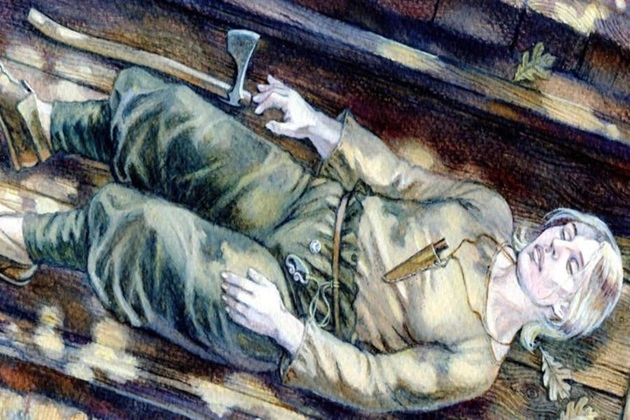
Reconstruction of a Scandinavian female warrior
Back in 1889, the grave of a noble medieval warrior was found near the Swedish town of Birka. The human skeleton rested next to 2 horses and a large number of expensive weapons. For more than a century, it was believed that the remains belonged, if not to a king (chief), then to some noble man. Until 2017, scientists conducted a DNA analysis of the Viking from Birka.
The study showed that the skeleton found more than a century ago is the remains of a woman. Thus, scientists have once again proved that in the Middle Ages in Scandinavian tribes, women sometimes fought alongside men. However, two years later, in 2019, a group of Polish archaeologists who worked on excavations in Scandinavia made a big discovery, proving that female warriors in the Middle Ages were not an exception, but rather an ordinary pattern. And not only in the Viking tribes.
Researchers have discovered more than 30 graves of medieval Amazons. Scientists were most interested in one of them on the island of Langeland in Denmark. Next to the remains of the woman in the grave was a battle axe, which, after examination, was identified as a weapon originating from the southern Baltic regions. This gave scientists the opportunity to assume with a high degree of confidence that the female warrior they found was by no means Scandinavian. Most likely, she belonged to one of the West Slavic tribes that lived at that time on the shores of the Baltic Sea: Lyutic, Obodrich or Pomoryan.
At the end of 2019, British scientists from Dandy University (Scotland) conducted a computer reconstruction of the face of one of the medieval female warriors, whose grave was discovered in the same year in the southern region of Norway. The Amazon’s head rested on a wooden shield, and there were many weapons next to the remains. Scientists have recorded an impressive scar in the frontal part of the skull. Experts consider it to be a trace of a wound in battle. All these finds fully confirm the truthfulness of the medieval Scandinavian sagas, which tell about numerous female warriors of that time.
The first homo sapiens in Europe
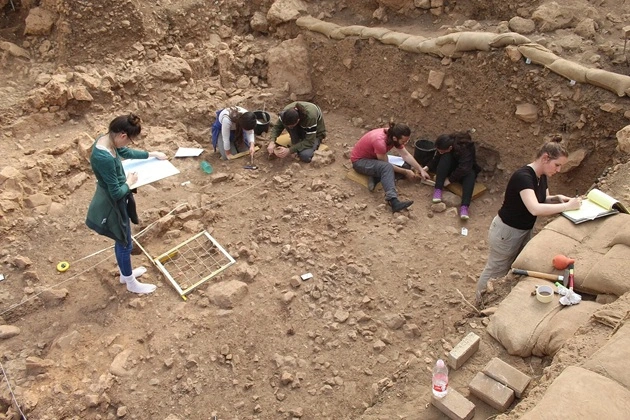
Excavations on Mount Carmel in Israel.
According to the latest archaeological finds made by scientists at excavations in Morocco, the modern human species homo sapiens has existed on the planet for at least 350 thousand years. People began to leave their “cradle”, Africa, and begin to conquer other continents about 70-55 millennia ago. This was believed until 2018, when scientists identified a human jaw found by archaeologists on Israel’s Mount Carmel. It was dated to an age of about 176-194 thousand years. But this discovery of homo sapiens’ first attempt to exit Africa lasted only a year. In 2019, using modern technologies, scientists were able to virtually reconstruct 2 skulls of ancient people, incomplete fragments of which were discovered by archaeologists in the Greek cave of Apidima back in the late 1970s. One of the skulls (named Apidima 2), which was 170 millennia old, belonged to a “native” of the European continent a Neanderthal.
The real sensation was caused by the reconstruction of the Apidima 1 skull. Studies have shown that its age is at least 210 thousand years old. And most importantly, this skull belonged to a “reasonable man.” It follows from this that the first attempts of homo sapiens to settle on the planet began more than 200 millennia ago. And although they were not successful (later only Neanderthals lived in the Apidima cave), after 150,000 years, nothing could stop the global expansion of the ancestors of modern humans.