The Pedoscope: A harmful scientific invention disguised as progress

In the 1920s, outlandish wooden Shoe-Fitting Fluoroscope cabinets began to appear in American shoe stores. The principle of operation was simple: by inserting a foot into the lower compartment, a potential buyer saw through a special tube how tightly the shoe fits on the foot. The device shone through the foot, allowing you to see every bone and contour of the sole. Clarence Karrer, a surgical instrument dealer, invented the Pedoscope in 1924, 29 years after Wilhelm Conrad Röntgen discovered the rays that were later named after him.
Why the Pedoscope quickly became popular
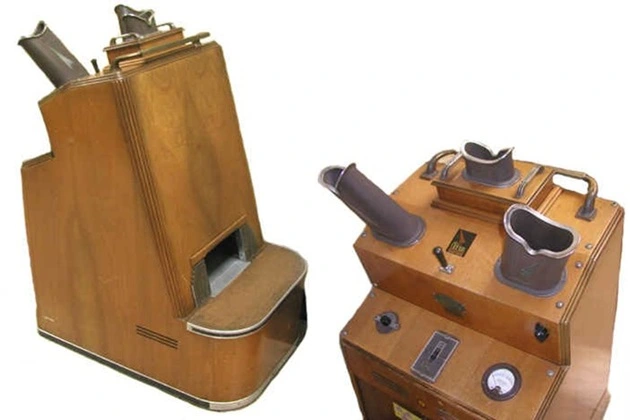
The price of a “shoe locker” with an X-ray ranged from $800 to $1,000. By comparison, for about $1,000 at that time, you could buy a car or a house. Despite the high cost, every store owner was eager to get a status novelty. The device began to capture shoe stores in North America and Europe, literally. In England, it was called Pedoscope; in Germany, it was called Shucoskop.
The peak of popularity occurred during the Great Depression: people tried to choose shoes wisely so that they could be worn for more than one season. By the end of the 1920s, there were about 10,000 pedoscopes in the United States alone, and about 3,000 in the UK. The ads were full of claims about scientific precision and perfect fit, guaranteeing comfort and leg health.
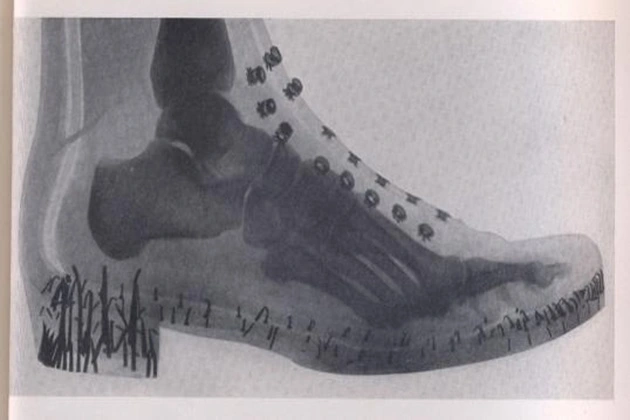
This is how it was described: “The leg miraculously entered, but upon entering, it became completely blind: the movement of the fingers inside was in no way reflected on the outer surface of the tight black skin. The saleswoman tied the ends of the shoelace with phenomenal speed — and touched the toe of the shoe with two fingers. “Just right! — She said. — There are always a few new ones… She continued hurriedly, raising her brown eyes. — Of course, if you want, you can put a scythe under your heel. But they are just the thing, see for yourself!” And she took him to the X-ray machine, showed him where to put his foot. Looking down through the window, he saw his own dark, neatly separated joints against a light background.”
Nabokov’s passage masterfully conveys not only the process itself, but also the psychological pressure that this device could exert. Visit. A F R I N I K . C O M . For the full article. Sellers quickly realized its marketing power: the opportunity to demonstrate the perfect or almost perfect fit of shoes right on the bones of the foot was an indisputable argument in favor of buying.
Especially for those who were in doubt, and parents who are worried about the healthy development of their child’s legs. “See for yourself” — This phrase has become a key one in the arsenal of pedoscope sellers. The device created the illusion of an absolutely accurate, scientifically based choice. The owners of pedoscopes were doing great until, in the late 1940s, scientists started talking about how harmful these devices were.
Why were pedoscopes withdrawn from sale
The device included an X-ray tube, which was located in the lower part of the cabin. The radiation passed through the foot and projected a shadow image of the bones and the contour of the shoe onto a fluorescent screen, which the buyer viewed through the viewing ports. Protection from stray radiation was minimal or completely absent, which became a fatal problem.
Pedoscopes did not pose a threat to customers, as there were no injuries. It was mainly the sellers who suffered: their hands were regularly exposed to direct rays (on average 114 microns/hour) when they felt the feet of customers. This led to dermatitis and other skin diseases. There was also a long-term risk of developing malignant tumors and radiation sickness. One of the most serious injuries related to the operation of the Pedoscope was recorded in a shoe model, who had to have her leg amputated as a result of radiation.
Legislators around the world have gradually begun to restrict the use of pedoscopes. The first measures appeared in the United States in the late 1940s, and by the 1970s, the devices had disappeared entirely from stores.